
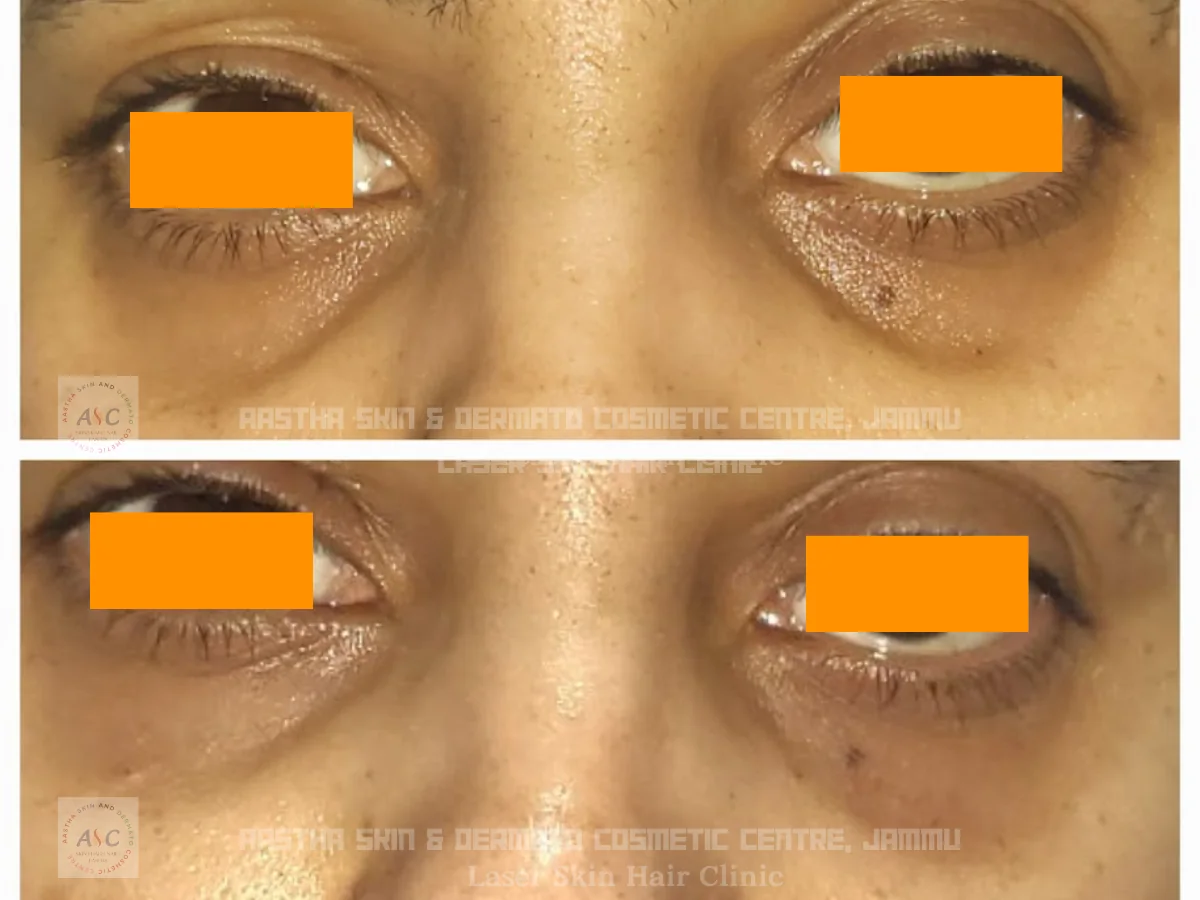
What are dark circles?
Dark circles are darker, bluish, purple, brown or shadowed areas beneath or around the eyes.
The medical terms may include:
- Periorbital hyperpigmentation
- Periocular pigmentation
- Infraorbital dark circles
- Periorbital melanosis
- Under-eye discolouration
They are usually a cosmetic concern rather than a dangerous disease, but the appearance may be caused by several different skin, vascular and structural factors.
What causes brown under-eye circles?
Brown under-eye circles may result from:
- Genetic or constitutional pigmentation
- Sun exposure
- Atopic dermatitis
- Allergic contact dermatitis
- Repeated rubbing
- Previous inflammation
- Pigmentation extending from nearby facial skin
- Age-related skin changes
- Certain medicines or cosmetic products
Brown colour that remains in different lighting usually suggests a pigment component, although many patients have a mixed pattern.
What causes blue or purple under-eye circles?
Blue, purple or reddish colour may become visible when:
- Under-eye skin is naturally thin
- Superficial blood vessels are prominent
- Skin becomes thinner with age
- There is temporary venous congestion
- Swelling makes vascular colour more obvious
- Pigmentation and visible vessels occur together
Treatments aimed only at melanin may produce limited improvement when the main problem is vascular visibility.
What is tear-trough shadowing?
The tear trough is the hollow extending from the inner corner of the lower eyelid towards the upper cheek.
Inherited facial anatomy, age-related volume loss, ligament changes and descent of nearby tissues can deepen this hollow. Light falling across it creates a shadow that looks like a dark circle even when the skin itself is not heavily pigmented.
Types, options and detailed guidance
What are the main types of dark circles?
Dark circles can be broadly classified as:
Brown or grey pigmentation is present within the skin.
Blue, violet or reddish tones appear because blood vessels are visible through thin under-eye skin.
A hollow tear trough, eye bag or facial contour creates a shadow.
Pigmentation follows eczema, contact dermatitis, rubbing or another inflammatory rash.
More than one factor is present, such as pigment combined with tear-trough hollowing.
This classification matters because pigment creams cannot fill a hollow, while filler does not remove genuine epidermal pigmentation.
Are under-eye bags the same as dark circles?
No.
Under-eye bags are areas of puffiness or protruding tissue beneath the lower eyelids. They can create a shadow below the swelling, making the area appear dark.
A patient can have:
- Dark circles without bags
- Bags without pigmentation
- Tear-trough hollowing with bags
- Pigment, hollowing and puffiness together
Large or persistent bags may require an oculoplastic or plastic-surgical opinion rather than pigmentation treatment alone.
Are dark circles caused only by lack of sleep?
No.
Poor sleep may make existing dark circles, puffiness or a tired appearance more noticeable, but persistent under-eye darkness is often influenced by genetics, pigmentation, anatomy, skin thickness or inflammation.
Someone who sleeps well can still have hereditary pigment or a deep tear trough. Likewise, improving sleep may help overall appearance without eliminating the underlying cause.
Are dark circles hereditary?
Yes.
Some people naturally have:
- More pigment around the eyes
- Thinner lower-eyelid skin
- More visible vessels
- A deeper tear trough
- Facial bone structure that creates shadowing
Hereditary dark circles may begin during childhood or adolescence and can become more noticeable with age. Treatment may reduce their appearance, but permanent complete removal should not be promised.
Can allergies cause dark circles?
Allergic conditions can contribute indirectly through:
- Eyelid inflammation
- Watering
- Puffiness
- Nasal congestion
- Frequent rubbing
- Post-inflammatory pigmentation
Treating associated allergy or dermatitis and stopping repeated rubbing may be an important part of the plan. Dark circles should not automatically be labelled an allergy without compatible symptoms and examination.
Can rubbing the eyes make dark circles worse?
Yes.
Repeated rubbing can:
- Irritate thin eyelid skin
- Worsen eczema
- Trigger contact dermatitis
- Produce post-inflammatory pigmentation
- Make swelling and blood vessels more visible
- Cause additional fine lines over time
The reason for rubbing, such as allergy, dry eyes, eczema or a cosmetic reaction, should be addressed rather than simply telling the patient to stop.
Can eczema cause under-eye pigmentation?
Yes.
Eczema can affect the eyelids and surrounding skin, causing itching, dryness, scaling and swelling. Repeated inflammation and scratching may leave persistent brown, grey or purple pigmentation after the active eczema improves.
Active eczema should be controlled before a chemical peel, laser or strong pigmentation cream is considered.
Can cosmetics cause dark circles?
Cosmetics may contribute when they cause irritant or allergic contact dermatitis.
Possible triggers include:
- Eye makeup
- Makeup remover
- Sunscreen
- Fragrance
- Preservatives
- Eyedrops
- Contact-lens solution
- Hair dye
- Nail polish
- Artificial nails
- Eyelash adhesive
A product used on the hair, nails or hands can reach the eyelids indirectly through touching.
Can ageing cause dark circles?
Yes.
Ageing may lead to:
- Thinner skin
- Reduced collagen
- Greater vessel visibility
- Deepening of the tear trough
- Mid-face volume loss
- Lower-eyelid fat prominence
- Skin laxity
- Fine lines and wrinkles
These changes can create both true discolouration and stronger shadows. Structural ageing generally requires a different approach from pigment-based dark circles.
Can sun exposure worsen under-eye pigmentation?
Yes.
Ultraviolet exposure can deepen melanin-related pigmentation and increase contrast between the under-eye area and surrounding skin. Sun protection is therefore an important part of pigment-based treatment and may also reduce post-inflammatory darkening after procedures.
Do dark circles mean someone has anaemia?
Not necessarily.
Dark circles alone cannot diagnose anaemia. Blood testing may be considered when a patient also reports symptoms such as:
- Unusual fatigue
- Weakness
- Breathlessness
- Paleness
- Dizziness
- Heavy menstrual bleeding
- Nutritional concerns
Routine iron supplementation should not be started solely because under-eye circles are present.
Additional care and practical advice
Can thyroid or kidney disease cause under-eye changes?
Some medical conditions can cause puffiness or facial changes, but ordinary dark circles alone are not enough to diagnose thyroid, kidney or another systemic disease.
Additional medical assessment may be appropriate when under-eye change occurs with:
- Generalised facial swelling
- Leg swelling
- Weight change
- Heat or cold intolerance
- Palpitations
- Severe fatigue
- Changes in urination
- Other systemic symptoms
Testing should be guided by history and examination rather than ordered as an automatic dark-circle package.
How do dark circles appear on Indian skin?
On Indian and deeper skin tones, dark circles may appear:
- Light brown
- Deep brown
- Grey-brown
- Purple-brown
- Blue-grey
- Almost black under certain lighting
Post-inflammatory pigmentation from rubbing, eczema and cosmetic reactions may be especially noticeable. Procedures that cause excessive irritation can worsen pigmentation, so treatment intensity must be selected carefully.
How does Dr. Cheena Langer assess dark circles?
A consultation may include:
- Examining the colour and distribution
- Checking whether darkness changes with lighting
- Assessing tear-trough depth and facial contours
- Looking for puffiness or eye bags
- Checking skin thickness and visible vessels
- Examining for eczema or contact dermatitis
- Asking about rubbing and allergies
- Reviewing sleep, skincare and cosmetic products
- Reviewing medicines and medical symptoms
- Assessing pigmentation risk in Indian skin
- Taking standardised photographs with consent
- Considering blood tests or specialist referral when indicated
A cause-based assessment is recommended because dark circles can be pigmentary, vascular, structural, inflammatory or mixed.
Cause-based assessment
Pigmentation, visible vessels, eczema, eye bags and tear-trough shadowing are considered separately.
Treatment suitable for Indian skin
The risk of irritation and post-inflammatory pigmentation is considered before selecting creams, peels or devices.
Eye-area safety
Treatments close to the eyelids are selected cautiously, with referral when an ophthalmic or surgical problem is suspected.
Multiple treatment options
Pigmentation care, chemical peels, Q-switched laser, IPL, fractional CO₂ and dermal fillers are listed as available at both branches, subject to individual suitability.
Realistic expectations
The clinic does not promise permanent dark-circle removal, flawless skin or identical improvement in every patient.
Additional cost depends on:
- Cause of the dark circles
- Prescription skincare
- Treatment of eczema or allergy
- Chemical peel
- IPL or laser treatment
- Fractional resurfacing
- Tear-trough filler
- Number of sessions
- Blood tests when medically indicated
- External ophthalmic or surgical referral
- Follow-up after the included 10-day period
A reliable cost estimate requires examination because pigment-based dark circles need a different plan from tear-trough hollowing or prominent eye bags.
How care is planned
- Assessment comes before treatment selection.
- Options, limitations, aftercare and expected timelines are explained.
- The plan is adapted to diagnosis, skin type and medical history.
Choose a clinic in Jammu
Karan Nagar
Lane 2, Karan Nagar, near Amphalla Chowk, Jammu – 180005Doctor consultation:
Mon–Sat 11:00 AM–4:00 PM
Sun 11:00 AM–3:00 PM
Paloura Chowk
Top Paloura, opposite Government Senior Secondary School, Jammu – 181121Doctor consultation:
Mon–Sat 6:00 PM–8:00 PM
Sun 10:30 AM–12:00 PM
Frequently asked questions
Can a stretch test help identify the cause?
During assessment, gently stretching or repositioning the lower-eyelid skin may help distinguish:
- True pigment
- Visible vascular colour
- Shadowing caused by a hollow
- A mixed pattern
If darkness improves substantially when the skin or cheek is repositioned, structural shadowing may be contributing. Clinical examination remains more useful than relying on a selfie or one lighting condition.
Are blood tests always required?
No.
Blood tests may be considered when the history suggests:
- Anaemia
- Nutritional deficiency
- Thyroid disease
- Systemic swelling
- Another medical condition
Most hereditary, pigmentary or tear-trough dark circles do not require an extensive investigation package.
Can dark circles be removed permanently?
Complete permanent removal cannot be guaranteed.
Treatment may:
- Lighten genuine pigmentation
- Reduce inflammation
- Improve surface texture
- Reduce vascular visibility
- Soften tear-trough shadowing
- Improve under-eye contour
- Make the area appear less tired
The result depends on the cause. Hereditary anatomy, natural skin thickness and ageing continue over time, so maintenance may be required.
What is the first step in treatment?
The first step is treating the dominant cause.
This may mean:
- Controlling eyelid eczema
- Stopping an allergenic product
- Reducing rubbing
- Improving sun protection
- Treating pigment carefully
- Addressing tear-trough hollowing
- Referring persistent eye bags for surgical assessment
- Investigating relevant medical symptoms
Starting several strong treatments simultaneously can make it difficult to identify what helped or caused irritation.
Which skincare measures may help?
A basic under-eye routine may include:
- Gentle fragrance-free cleansing
- A suitable moisturiser
- Broad-spectrum sunscreen
- Avoiding repeated rubbing
- Removing eye makeup gently
- Treating active dermatitis
- Avoiding harsh scrubs and strong home peels
- Using prescribed products only in the advised area
The eyelid region is thin and easily irritated, so products suitable for the cheeks may be too strong for use close to the eye.
Which topical medicines may be used?
Depending on the cause and skin sensitivity, a dermatologist may consider:
- A topical retinoid
- Azelaic acid
- Vitamin C
- A carefully supervised depigmenting agent
- A barrier-repair moisturiser
- Anti-inflammatory treatment for eczema
- Another pigment-modulating ingredient
Systematic reviews suggest that topical creams and serums may help pigment-based dark circles, but the available evidence is limited and results vary.
Is hydroquinone used under the eyes?
Hydroquinone may be considered for selected pigment-based cases, but the eyelid area requires cautious use.
Incorrect strength, prolonged use or application too close to the eye may cause:
- Irritation
- Dryness
- Contact dermatitis
- Uneven lightening
- Rebound pigmentation
- Rare long-term complications
It should not be used indefinitely or purchased in strong unregulated combinations without medical supervision.
Get a clear plan for dark circles & under-eye
Request a consultation with Dr. Cheena Langer at Karan Nagar or Paloura Chowk.
Medical disclaimer: Results may vary from person to person. This content is for informational purposes only and does not substitute a consultation with a qualified medical professional. Dr. Cheena Langer, MD is a registered medical practitioner.