
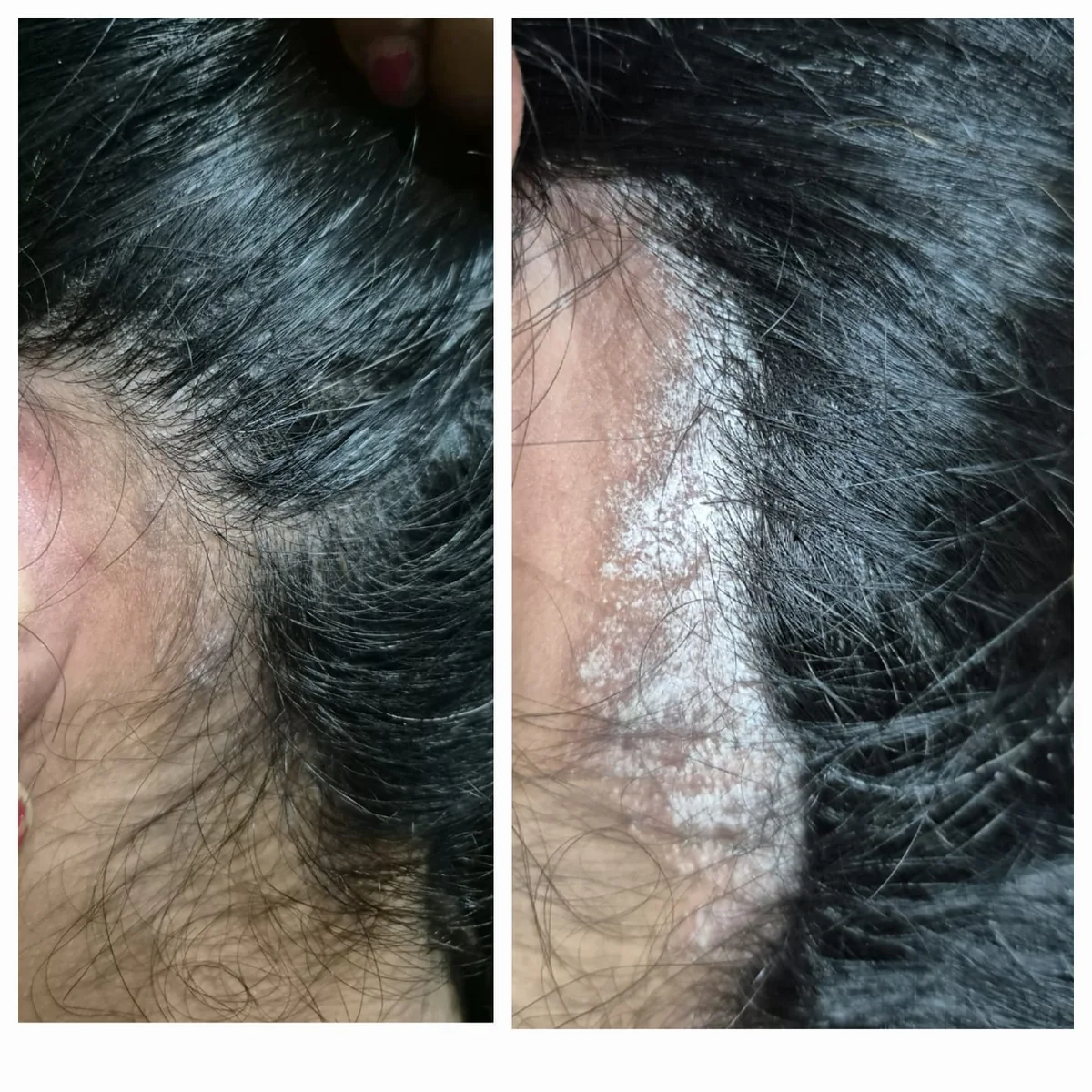
What is psoriasis?
Psoriasis is a long-lasting immune-mediated inflammatory disease.
In healthy skin, new cells normally develop and move towards the surface gradually. In psoriasis, this process becomes unusually rapid. Skin cells accumulate before older cells can shed normally, producing thickened patches and scale.
Psoriasis can affect:
- Skin
- Scalp
- Fingernails and toenails
- Palms and soles
- Skin folds
- Genital skin
- Joints in people who develop psoriatic arthritis
Symptoms often follow a cycle, with periods of improvement followed by unpredictable flare-ups.
What is scalp psoriasis?
Scalp psoriasis can affect a small area or cover most of the scalp.
It may cause:
- Thick scale
- Dandruff-like flaking
- Itching
- Burning
- Cracking
- Bleeding after scratching
- Patches extending behind the ears or beyond the hairline
- Temporary hair shedding
Scalp psoriasis can resemble ordinary dandruff or seborrhoeic dermatitis. Diagnosis is important because treatment products and strengths may differ.
Hair usually regrows when inflammation settles, although forceful scratching or pulling away adherent scale can increase breakage and shedding.
Types, options and detailed guidance
Is psoriasis contagious?
No. Psoriasis is not contagious.
It cannot spread through:
- Touching
- Hugging
- Sharing towels
- Swimming together
- Sexual contact
- Sharing food
- Living in the same household
Psoriasis is related to immune-system activity, genetic susceptibility and environmental triggers. It is not caused by an infection that can pass from one person to another.
Is psoriasis caused by poor hygiene?
No.
Psoriasis is not caused by:
- Dirty skin
- Infrequent bathing
- Poor personal hygiene
- Eating a particular food
- A fungal infection
- Failure to exfoliate
- Contact with another patient
Aggressive scrubbing can irritate the skin and may worsen psoriasis rather than remove it.
What does psoriasis look like?
The appearance varies according to the type, body area and natural skin tone.
Common signs include:
- Raised or thickened patches
- Dry scale
- Itching
- Burning
- Soreness
- Cracking
- Bleeding after scratching
- Flaking from the scalp
- Changes in the nails
Plaque psoriasis frequently affects the elbows, knees, scalp and lower back, although it can appear anywhere.
How does psoriasis appear on Indian skin?
On lighter skin, psoriasis often looks pink or red with silvery-white scale.
On medium-to-deep skin tones, it may look:
- Violet
- Purple-brown
- Dark brown
- Greyish
- Less visibly red
- More thickly scaled
After a flare clears, Indian skin may retain temporary darker or lighter patches. These colour changes are not necessarily scars and may take months to fade.
This difference in appearance can sometimes cause psoriasis to be mistaken for fungal infection, eczema or pigmentation.
Plaque psoriasis
This is the most common form. It produces raised plaques with scale, frequently on the scalp, elbows, knees or lower back.
Guttate psoriasis
Guttate psoriasis produces many small scaly spots, often across the trunk, arms or legs. It can begin after an infection such as streptococcal throat infection and is seen commonly in children and young adults.
Inverse psoriasis
Inverse or flexural psoriasis affects skin folds such as:
- Underarms
- Groin
- Beneath the breasts
- Buttock crease
It may appear smooth, shiny, sore and inflamed, with less obvious scale because of moisture and friction.
Pustular psoriasis
Pustular psoriasis causes pus-filled bumps on inflamed skin. Localised forms may affect the palms and soles. Widespread pustular psoriasis accompanied by fever or chills requires urgent medical care.
Erythrodermic psoriasis
Erythrodermic psoriasis causes extensive inflammation and shedding over a large part of the body. It may disturb body temperature and fluid balance and can become life-threatening.
What is nail psoriasis?
Psoriasis may affect one or more fingernails or toenails.
Possible signs include:
- Tiny pits
- Yellow, white or brown discolouration
- Crumbling
- Thickening
- Separation from the nail bed
- Debris beneath the nail
- Pain or tenderness
Nail psoriasis may occur with or without obvious skin plaques. Nail changes can also be associated with psoriatic arthritis, so they should be mentioned during consultation.
Fungal nail infection can look similar and may need testing before treatment.
Can psoriasis affect the face or genital area?
Yes.
Psoriasis can affect:
- Eyelids
- Hairline
- Behind the ears
- Around the nose
- Genital skin
- Groin folds
- Buttock crease
These areas have thinner or more sensitive skin, so medication prescribed for an elbow or knee may be unsuitable for the face or genital region. A separate treatment plan may be needed.
Genital psoriasis is not sexually transmitted and cannot be passed to a partner.
What causes psoriasis?
Psoriasis appears to result from an interaction between:
- Genetic susceptibility
- Immune-system activity
- Environmental triggers
Having a relative with psoriasis can increase risk, but not everyone with a family history develops the condition. A trigger may cause psoriasis to appear or flare in a genetically susceptible person.
What can trigger a psoriasis flare?
Triggers differ between patients and may include:
- Emotional stress
- Skin injury
- Cuts or scratches
- Sunburn
- Throat or other infections
- Cold, dry weather
- Smoking
- Heavy alcohol use
- Certain medicines
- Abrupt changes to some systemic treatments
Patients should not stop a prescribed medicine independently. Tell the prescribing doctor when a suspected medicine appears to worsen psoriasis.
Additional care and practical advice
Can an injury cause a new psoriasis patch?
Yes. Psoriasis can sometimes appear in an area of injured skin.
Possible triggers include:
- Scratching
- Cuts
- Burns
- Tattoos
- Insect bites
- Surgical wounds
- Repeated friction
- Severe sunburn
Avoiding preventable skin injury and treating itching can help reduce this type of flare.
Is psoriasis the same as fungal infection?
No.
Psoriasis
- Chronic inflammatory condition
- Not contagious
- May affect scalp, nails and joints
- Often recurs in similar areas
- Requires anti-inflammatory or immune-directed treatment
Fungal infection
- Caused by fungi
- Can spread between people or body areas
- Often requires antifungal medicine
- May be confirmed through skin or nail testing
Both can cause scaling and itching. Using a steroid-containing mixed cream on an undiagnosed fungal infection can change its appearance and allow it to spread.
Is psoriasis the same as eczema?
No, although the conditions can occasionally look similar.
Eczema commonly produces intense itching, dryness and inflamed patches. Psoriasis more often produces sharply defined, thickened plaques with scale, but these textbook differences are not present in every patient.
Both conditions can affect:
- Scalp
- Face
- Hands
- Skin folds
- Children
- Adults
A dermatologist may occasionally recommend a skin biopsy when the diagnosis remains uncertain.
Correct diagnosis before long-term treatment
Psoriasis is distinguished from fungal infection, eczema, seborrhoeic dermatitis and other scaly conditions.
Skin, scalp and nail assessment
The consultation looks beyond visible body plaques and checks areas that may require a different treatment plan.
Joint-symptom screening
Patients are asked about stiffness, swollen joints, heel pain and other signs that may suggest psoriatic arthritis.
Dermatologist-led management
Care is provided under Dr. Cheena Langer, MBBS, MD Dermatology, Consultant Dermatologist.
Treatment matched to severity
The plan may include moisturisers, topical medicine, monitoring, laboratory tests, systemic-treatment evaluation or referral for phototherapy or rheumatology care where appropriate.
Long-term, realistic counselling
Psoriasis is managed as a recurring inflammatory condition, not advertised as a one-time cure.
Additional cost depends on:
- Type and severity of psoriasis
- Prescription creams or scalp solutions
- Blood tests
- Skin biopsy when diagnosis is uncertain
- Systemic medicine
- Infection screening
- Phototherapy referral
- Rheumatology consultation
- Frequency of monitoring
- Follow-up after the included 10-day period
The treatment plan and expected monitoring costs are discussed after examination.
How care is planned
- Assessment comes before treatment selection.
- Options, limitations, aftercare and expected timelines are explained.
- The plan is adapted to diagnosis, skin type and medical history.
Choose a clinic in Jammu
Karan Nagar
Lane 2, Karan Nagar, near Amphalla Chowk, Jammu – 180005Doctor consultation:
Mon–Sat 11:00 AM–4:00 PM
Sun 11:00 AM–3:00 PM
Paloura Chowk
Top Paloura, opposite Government Senior Secondary School, Jammu – 181121Doctor consultation:
Mon–Sat 6:00 PM–8:00 PM
Sun 10:30 AM–12:00 PM
Frequently asked questions
How does Dr. Cheena Langer diagnose psoriasis?
Assessment may include:
- Examining the skin and scalp
- Checking fingernails and toenails
- Reviewing itching, pain and flare duration
- Asking about family history
- Reviewing recent infections or stress
- Reviewing medicines
- Asking about joint pain or stiffness
- Assessing the extent and location of plaques
- Evaluating effects on sleep, work and confidence
- Considering skin biopsy or another test when necessary
Psoriasis is often diagnosed clinically. A small skin sample may be examined when another condition needs to be excluded.
How is psoriasis severity assessed?
Severity is not determined only by the total area involved.
Assessment may consider:
- Percentage of body surface affected
- Plaque redness, thickness and scale
- Scalp, nail, palm or sole involvement
- Genital or facial involvement
- Itching and pain
- Cracking and bleeding
- Effect on work or school
- Effect on sleep
- Psychological or social impact
- Response to previous treatment
Even a small area can be severe when it affects the hands, feet, face, genitals or nails. NICE recommends considering both physical severity and the impact on psychological and social wellbeing.
Can psoriasis be cured permanently?
There is currently no permanent cure, but suitable treatment can provide clear or nearly clear skin, reduce symptoms and keep the condition controlled.
What are the goals of psoriasis treatment?
Treatment aims to:
- Reduce inflammation
- Relieve itching, burning and pain
- Remove or soften scale
- Clear or reduce plaques
- Treat scalp and nail disease
- Improve sleep and daily functioning
- Reduce psychological impact
- Identify joint symptoms early
- Maintain control with the least burdensome suitable plan
No single treatment works for every patient. Dermatologists may use one treatment or combine several approaches.
Which topical treatments may be used?
Mild or limited psoriasis is often managed with medicine applied directly to the skin.
Depending on the location and patient, a treatment plan may include:
- Topical corticosteroids
- Vitamin D–related medicines
- Scale-softening treatments
- Selected retinoid preparations
- Coal-tar preparations
- Calcineurin inhibitors for sensitive areas
- Newer non-steroid prescription preparations
- Moisturisers and emollients
The strength and duration must be matched to the body area. Face, groin and skin-fold treatment generally differs from treatment used on thick plaques over elbows or knees.
Are steroid creams safe for psoriasis?
Topical corticosteroids are widely used and can reduce inflammation, itching and plaque thickness.
Safe use depends on:
- Correct strength
- Correct body area
- Correct amount
- Appropriate duration
- Planned breaks or maintenance
- Follow-up when treatment is prolonged
Strong steroids used excessively can cause thinning, stretch marks, visible blood vessels, acne-like eruptions or rebound problems. Patients should not repeatedly apply an old prescription without review.
Steroid-antifungal-antibiotic combination creams should not be used as a general solution for every itchy rash.
Does moisturiser help psoriasis?
Yes. Moisturiser does not cure psoriasis, but it can support almost every treatment plan.
Regular moisturising may help:
- Reduce dryness
- Soften scale
- Ease cracking
- Reduce discomfort
- Support the skin barrier
- Reduce irritation caused by friction
AAD guidance notes that moisturisers can benefit patients across different levels of psoriasis severity.
Fragrance-free ointments or thick creams are often better tolerated than highly perfumed cosmetic lotions.
Get a clear plan for psoriasis
Request a consultation with Dr. Cheena Langer at Karan Nagar or Paloura Chowk.
Medical disclaimer: Results may vary from person to person. This content is for informational purposes only and does not substitute a consultation with a qualified medical professional. Dr. Cheena Langer, MD is a registered medical practitioner.