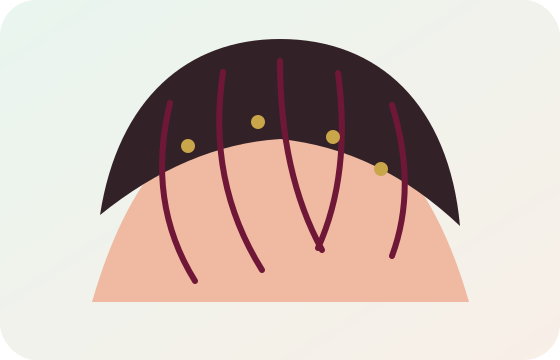
What is white or grey hair?
Hair receives its colour from melanin produced within the hair follicle.
Hair becomes grey or white when the follicle produces less melanin or stops producing it. Grey hair retains some pigment, while completely white hair has very little or no visible melanin in the hair shaft.
White hair may appear on the:
- Scalp
- Eyebrows
- Beard
- Moustache
- Chin
- Upper lip
- Cheeks
- Neck
- Chest
- Arms
- Other body areas
What is electrolysis?
Electrolysis treats one hair follicle at a time.
A very fine sterile probe is inserted into the follicular opening. Electrical energy is then delivered to damage the hair-producing structures, after which the loosened hair is removed.
Unlike laser treatment, electrolysis does not depend on the hair containing melanin. It can therefore be used for:
- White hair
- Grey hair
- Blonde hair
- Red hair
- Dark hair
- Fine isolated hairs
- Mixed-colour facial hair
Types, options and detailed guidance
What does “white hair removal” mean on this page?
This page concerns the removal of unwanted white or grey facial and body hair.
It does not refer primarily to:
- Reversing grey scalp hair
- Dyeing scalp or beard hair
- Treating hair loss
- Restoring pigment to vitiligo-affected hair
- Hair transplantation
A patient seeking treatment for premature greying may need a separate hair-and-scalp assessment rather than a hair-removal procedure.
Why does unwanted facial hair turn white?
Facial hair can lose pigment because of:
- Normal ageing
- Family or genetic tendency
- Premature greying
- Reduced follicular melanin production
- Vitiligo or poliosis
- Previous inflammation
- Selected medicines or medical conditions
- Hair growing back after earlier dark-hair reduction while residual white hairs remain
Age-related greying is common and is not usually a disease.
Does white facial hair mean something is medically wrong?
Usually not.
A few white chin or facial hairs commonly develop with age. Medical assessment becomes more relevant when the change is:
- Very early in life
- Sudden or rapidly progressive
- Associated with hair loss
- Confined to a white skin patch
- Accompanied by fatigue or weight change
- Associated with irregular periods or severe acne
- Accompanied by rapidly increasing coarse facial hair
- Linked with another autoimmune or nutritional concern
The decision to investigate depends on the full clinical picture rather than the colour of one or two hairs.
Can white hair become naturally dark again?
Established age-related white hair usually does not reliably regain its original colour.
Premature greying has been associated in some studies with family history, smoking, thyroid disorders and selected nutritional deficiencies, but the evidence is inconsistent and treatment does not guarantee repigmentation. Supplements should be used only when a genuine deficiency or medical indication is identified.
Removal and repigmentation are different goals. A treatment that removes a white hair does not restore its colour.
Why does conventional laser hair reduction not work on white hair?
Hair-removal lasers work through selective photothermolysis.
Laser energy is absorbed by melanin in a dark hair shaft and transferred to the follicle. White hair lacks enough pigment to absorb the required energy, so the laser cannot reliably distinguish it from the surrounding skin.
The American Academy of Dermatology specifically notes that laser hair removal does not work effectively on white, grey, blonde or red hair.
Can a stronger laser setting remove white hair?
No reliable benefit should be expected simply from increasing the energy.
Using excessive energy when the hair lacks a suitable pigment target can increase the risk of:
- Burns
- Blisters
- Crusting
- Infection
- Dark pigmentation
- Light pigmentation
- Scarring
The limitation is the absence of pigment within the hair, not merely insufficient machine power.
Can diode or Nd:YAG laser remove white hair?
Diode and long-pulsed Nd:YAG lasers can reduce suitable pigmented hair when the correct patient, skin type and settings are selected.
They still depend on a pigment target within the hair. A fully white hair generally cannot be treated effectively merely by changing from one conventional hair-removal wavelength to another.
Laser hair reduction is confirmed at both Aastha branches, but it should be used only for suitable pigmented hairs.
Can IPL remove white or grey hair?
IPL also relies largely on pigment within the hair shaft.
It is therefore generally ineffective for completely white hair. Treating pigment-free hair repeatedly with IPL can expose the surrounding skin to heat without producing meaningful follicular reduction.
Experimental methods that add an external chromophore or photosensitiser have been studied, but available research is limited and has not established a routine, dependable white-hair removal protocol.
Is electrolysis permanent?
Electrolysis is recognised as a method capable of permanently removing successfully treated individual follicles.
However, several practical limitations remain:
- Every follicle must be treated separately
- Not every hair is visible or treatable during one session
- Hair grows in cycles
- Some follicles may require repeat treatment
- New hormonally influenced hairs may develop later
- Results depend heavily on operator technique
Several sessions are therefore needed even when the eventual goal is permanent removal of the treated hairs.
Why are multiple electrolysis sessions needed?
Hair follicles pass through active growth, transition and resting phases.
A session only treats hairs that are present and accessible at that time. Other follicles may produce visible hairs during later weeks or months.
The total treatment period depends on:
- Number of hairs
- Body area
- Hair-growth cycle
- Hair thickness
- Hormonal influences
- Previous waxing or plucking
- Session length
- Skin response
- Consistency of appointments
No fixed session count should be promised before the area has been assessed.
Is electrolysis suitable for Indian skin?
Electrolysis can be performed across different skin tones because it does not rely on colour contrast between the skin and hair.
Indian and deeper skin tones can nevertheless develop:
- Temporary redness
- Small crusts
- Post-inflammatory hyperpigmentation
- Light spots
- Burns
- Infection
- Scarring
- Keloids in susceptible patients
The AAD advises choosing an appropriately trained professional because poor technique or unsterile probes can cause burns, scars and infection.
Honest laser suitability assessment
Fully white hair is not presented as a routine laser indication.
Mixed-hair planning
Dark and white hairs can be separated so that laser is considered only for suitable pigmented hairs.
Hormonal symptoms considered
Rapid or excessive facial-hair growth can be evaluated rather than treated only as a cosmetic concern.
Indian-skin considerations
Pigmentation, folliculitis and keloid risk are reviewed before a procedure is selected.
Dermatologist-led consultation
Assessment is provided under Dr. Cheena Langer, MBBS, MD Dermatology, Consultant Dermatologist, with more than 20 years in medicine.
Transparent availability
Electrolysis or another white-hair-specific procedure is not claimed as available until the clinic confirms the equipment, trained operator, branch and current appointment status.
Additional cost depends on:
- Number of white hairs
- Size of the treatment area
- Facial or body location
- Hair thickness
- Electrolysis availability
- Session duration
- Number of sessions
- Mixed laser-and-electrolysis planning
- Hormonal investigations
- Prescription treatment
- External referral
- Follow-up after the included 10-day period
A reliable quote requires assessment because removing a few isolated chin hairs differs substantially from treating dense white facial or neck hair.
How care is planned
- Assessment comes before treatment selection.
- Options, limitations, aftercare and expected timelines are explained.
- The plan is adapted to diagnosis, skin type and medical history.
Choose a clinic in Jammu
Karan Nagar
Lane 2, Karan Nagar, near Amphalla Chowk, Jammu – 180005Doctor consultation:
Mon–Sat 11:00 AM–4:00 PM
Sun 11:00 AM–3:00 PM
Paloura Chowk
Top Paloura, opposite Government Senior Secondary School, Jammu – 181121Doctor consultation:
Mon–Sat 6:00 PM–8:00 PM
Sun 10:30 AM–12:00 PM
Frequently asked questions
Can black and white hairs be treated together?
Yes, but different methods may be required.
A mixed-hair plan may involve:
- Laser hair reduction for suitable dark, coarse hairs
- Electrolysis for residual white or grey hairs
- Temporary trimming or shaving between sessions when advised
- Medical treatment when ongoing hormonal hair growth is present
Laser treatment should not be counted as a white-hair treatment merely because dark and white hairs are present in the same area.
Can white facial hair be shaved?
Yes.
Shaving cuts the hair at the skin surface. It does not:
- Increase the number of follicles
- Make the hair biologically thicker
- Turn nearby hair white
- Make hair grow faster
- Change the follicle’s pigment production
The blunt cut end may feel coarser while it grows out, but the underlying hair has not changed.
Shaving is a reasonable temporary option when the skin tolerates it.
Can white hair be plucked or tweezed?
Plucking removes an individual hair from the follicle temporarily.
Possible disadvantages include:
- Pain
- Folliculitis
- Ingrown hair
- Red bumps
- Pigmentation
- Small scars
- Difficulty identifying hairs for electrolysis
- Repeated skin trauma
Frequent plucking does not create more hair, but it may complicate a planned electrolysis schedule because the hair must be visible and connected with the follicle for treatment.
Can threading or waxing remove white hair?
Yes, both methods remove the hair mechanically and do not depend on pigment.
Their effects are temporary. Possible problems include:
- Irritation
- Folliculitis
- Skin lifting
- Burns from hot wax
- Ingrown hair
- Post-inflammatory pigmentation
- Contact allergy to wax or products
- Worsening of active acne or dermatitis
Waxing should generally be avoided immediately before electrolysis or laser assessment.
Are hair-removal creams suitable?
Chemical depilatories dissolve hair near the skin surface.
They may remove white hair temporarily, but sensitive facial skin can develop:
- Burning
- Irritant dermatitis
- Allergic contact dermatitis
- Swelling
- Dark pigmentation
- Chemical injury
A patch test should be performed according to the product instructions. Products should not be used near the eyes, on broken skin or on areas for which the manufacturer has not approved their use.
Can home IPL devices remove white hair?
No reliable white-hair reduction should be expected from a home IPL device.
These devices also depend on light absorption by pigment. A device that cannot detect sufficient contrast may refuse to fire, while unsuitable use can still irritate or burn the surrounding skin.
Patients should not repeatedly increase settings in an attempt to make white hair respond.
When should excess facial hair be medically evaluated?
Medical assessment may be appropriate when a woman develops:
- Rapidly increasing coarse facial hair
- Irregular or absent periods
- Severe or persistent acne
- Scalp-hair thinning
- Voice deepening
- Increased muscularity
- Unexplained weight change
- Dark, velvety neck skin
- Fertility concerns
- Sudden hair growth after menopause
Hirsutism may be associated with PCOS or another androgen-related condition. Endocrine guidance recommends considering androgen testing when hair growth is clinically significant, rapidly progressive or accompanied by menstrual or other endocrine abnormalities.
The hair may become white with age, but the reason it is growing can still require evaluation.
Get a clear plan for white & grey hair removal
Request a consultation with Dr. Cheena Langer at Karan Nagar or Paloura Chowk.
Medical disclaimer: Results may vary from person to person. This content is for informational purposes only and does not substitute a consultation with a qualified medical professional. Dr. Cheena Langer, MD is a registered medical practitioner.