What is alopecia areata?
Alopecia areata is a chronic, unpredictable autoimmune hair-loss condition.
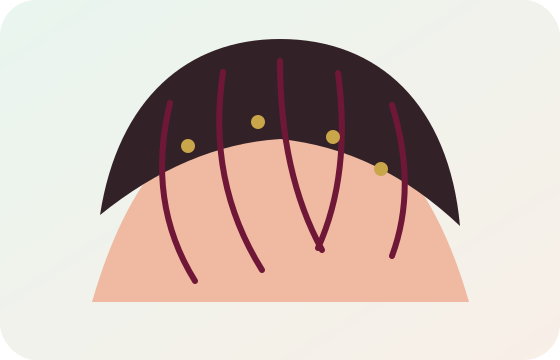
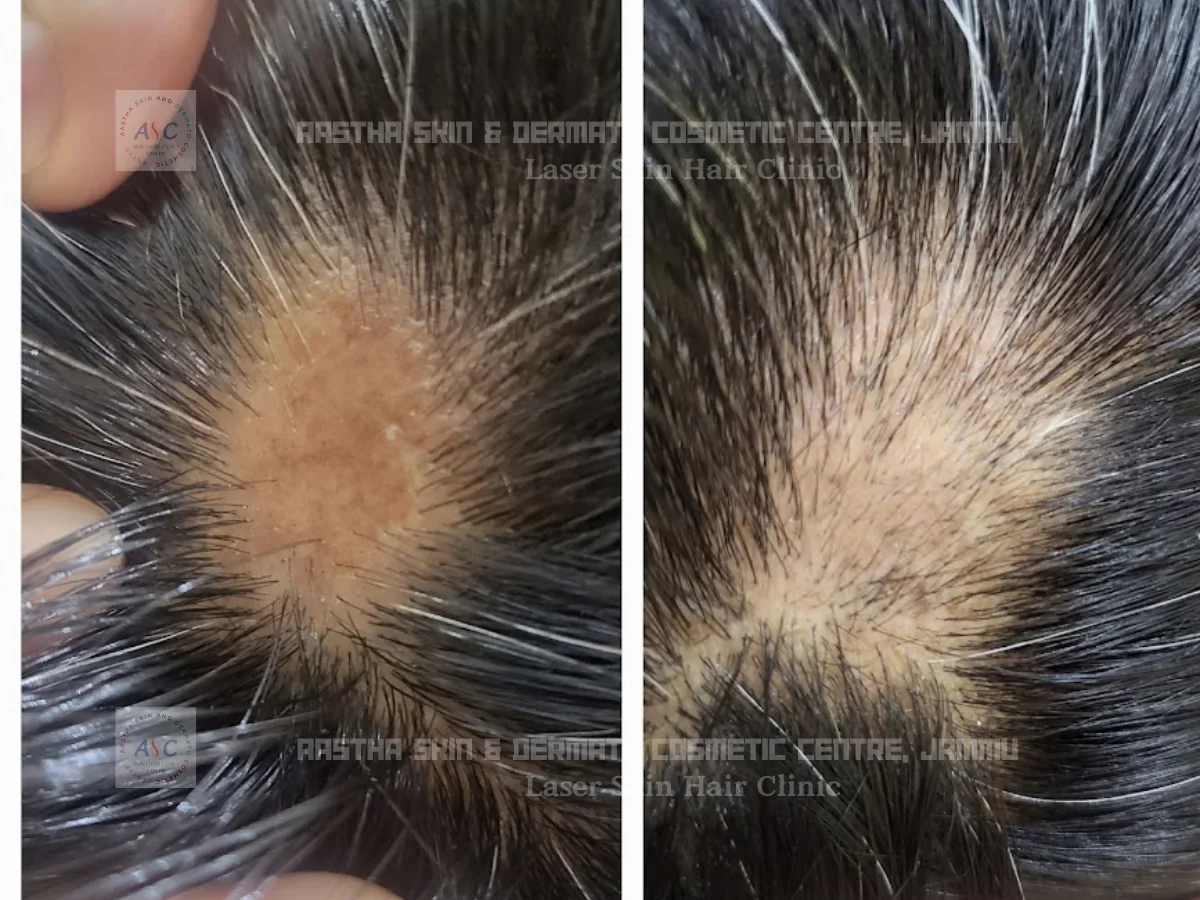
The immune system mistakenly targets hair follicles during their active growth phase. This causes affected hairs to shed, often leaving one or more smooth bald patches.
The follicles are generally not permanently destroyed, which means regrowth remains possible. However, the amount, speed and durability of regrowth differ greatly between patients.
What are the common signs?
Possible signs include:
- One or more smooth round bald patches
- Oval areas of sudden hair loss
- Patchy beard loss
- Eyebrow or eyelash loss
- Short broken hairs near the patch border
- Fine regrowing hairs
- White or grey regrowth
- Nail pitting or roughness
- Tingling, itching or burning before hair falls
The scalp skin often looks normal rather than scaly, crusted or severely inflamed.
What is patchy alopecia areata?
Patchy alopecia areata is the most familiar form.
It produces one or several smooth areas of hair loss on the scalp, beard or body. A small number of recent patches may regrow spontaneously, particularly when the disease has been present for less than a year.
Treatment may still be considered when the patches are enlarging, visible, recurring or distressing.
What is alopecia totalis?
Alopecia totalis means near-complete or complete loss of scalp hair.
It represents a more extensive form of alopecia areata. Eyebrows, eyelashes or body hair may also be affected.
Spontaneous full regrowth is less predictable than it is in limited patchy disease, and systemic treatment assessment may be considered.
What is alopecia universalis?
Alopecia universalis causes extensive loss of hair from the scalp and body.
It may involve:
- Scalp hair
- Eyebrows
- Eyelashes
- Beard
- Underarm hair
- Pubic hair
- Other body hair
The condition is not dangerous by itself, but loss of eyelashes, eyebrows and nostril hair reduces some natural protection from sunlight, dust and airborne particles.
What is ophiasis-pattern alopecia?
Ophiasis describes a band-like pattern of hair loss around the:
- Back of the scalp
- Sides of the scalp
- Area above the ears
This pattern can be more resistant to treatment than one or two central scalp patches.
It should be distinguished from traction alopecia, fungal infection and other conditions affecting the scalp margins.
Types, options and detailed guidance
Is alopecia areata a scarring hair-loss condition?
Usually not.
Alopecia areata is classified as non-scarring alopecia. The skin within a typical patch usually remains smooth, and the follicular openings are preserved.
This distinction matters because scarring alopecias permanently damage hair follicles and may require rapid anti-inflammatory treatment to prevent irreversible loss.
A patch that is painful, inflamed, shiny, scarred or associated with pustules should be assessed for another diagnosis.
What are exclamation-mark hairs?
Exclamation-mark hairs are short hairs that become narrower near the scalp and wider towards the tip.
They may be seen around the edge of an active alopecia areata patch. They are not present in every patient, and their absence does not exclude the diagnosis.
A dermatologist may identify them using close examination or dermoscopy.
How does alopecia areata appear on Indian hair and skin?
The bald area usually appears smooth regardless of skin tone.
On Indian skin, the contrast between the scalp and dark hair can make even a small patch highly visible. Broken hairs, black dots and fine regrowth may be easier to appreciate with dermoscopy.
Temporary changes in scalp colour can also result from:
- Sun exposure on a newly bare patch
- Previous irritating treatments
- Steroid misuse
- Fungal infection
- Scratching or inflammation
The diagnosis should not be based only on the shape of the patch.
Can alopecia areata affect the beard?
Yes.
Beard alopecia areata can produce one or more smooth hairless patches on the:
- Chin
- Jawline
- Cheeks
- Moustache area
- Neck
It can resemble fungal beard infection, shaving irritation or scarring disease. Scaling, pus, pain or significant inflammation may indicate another cause.
Treatment options are selected according to patch size, duration and facial-skin sensitivity.
Can eyebrows and eyelashes be affected?
Yes.
Alopecia areata may cause partial or complete loss of eyebrows or eyelashes.
Eyelash loss can increase irritation from:
- Dust
- Wind
- Sunlight
- Dryness
- Small particles entering the eyes
Glasses or sunglasses may provide practical protection. Artificial eyebrows, temporary cosmetics or carefully selected medical treatment may also be discussed.
Eye pain, marked redness or visual change requires appropriate eye assessment.
Can alopecia areata affect the nails?
Yes.
Possible nail changes include:
- Tiny pits
- Rough surface
- Brittle nails
- Longitudinal ridging
- Thinning
- Splitting
- Crumbling in severe cases
Nail changes can occur with limited or extensive hair loss. Patients should mention them because they may help support the diagnosis and assess disease burden.
Is alopecia areata contagious?
No.
Alopecia areata cannot spread through:
- Touching
- Sharing combs
- Towels
- Pillows
- Haircuts
- Food
- Swimming
- Living together
It is an immune-mediated condition, not a fungal, bacterial or viral infection.
Is alopecia areata caused by poor hair care?
No.
It is not caused by:
- Dirty hair
- Infrequent shampooing
- Dandruff alone
- Applying oil
- Cutting the hair too short
- Sharing a comb
- Eating a particular food
- Failure to take supplements
Hair products or tight hairstyles can cause other types of hair loss, but they do not explain ordinary autoimmune alopecia areata.
What causes alopecia areata?
The exact trigger cannot always be identified.
The condition appears to involve:
- Autoimmune activity
- Genetic susceptibility
- Immune signalling around hair follicles
- Environmental influences
- Possible illness or stress-related triggers in some patients
A relative may have alopecia areata or another autoimmune condition, but many patients have no affected family member.
Does stress cause alopecia areata?
Stress may precede or aggravate hair loss in some people, but it is not the sole explanation for the disease.
Alopecia areata involves measurable immune activity around hair follicles. Telling a patient to “stop stressing” is neither a diagnosis nor a complete treatment plan.
Stress management can support wellbeing, especially when visible hair loss causes anxiety, but it does not replace dermatological care.
Can children develop alopecia areata?
Yes.
Alopecia areata can begin during childhood and may cause:
- One or more scalp patches
- Eyebrow or eyelash loss
- Nail pitting
- Recurrent episodes
- Distress at school
- Bullying or unwanted attention
Some children with limited disease regrow hair without treatment. When treatment is needed, age, disease extent, discomfort and treatment burden must be considered. Topical corticosteroids are commonly considered before painful scalp injections in young children.
Is alopecia areata associated with other conditions?
People with alopecia areata have a higher likelihood of certain immune-related conditions, including:
- Autoimmune thyroid disease
- Atopic dermatitis or eczema
- Vitiligo
- Other autoimmune disorders in selected patients
This does not mean every patient needs a large panel of blood tests or will develop another disease. Investigation should be guided by symptoms, history and examination.
Which symptoms should be mentioned during consultation?
Tell Dr. Cheena Langer about:
- Unexplained tiredness
- Weight change
- Heat or cold intolerance
- Palpitations
- White skin patches
- Persistent eczema
- Joint symptoms
- Other autoimmune disease
- New medicine use
- Recent illness
- Family history of hair loss or autoimmunity
These details may influence the investigation and treatment plan.
Is every round bald patch alopecia areata?
No.
Other possible causes include:
- Scalp ringworm
- Hair pulling
- Traction alopecia
- Pattern hair loss
- Telogen effluvium
- Scarring alopecia
- Lupus-related hair loss
- Syphilitic alopecia
- Pressure or friction
- Hair-shaft breakage
Treatment differs significantly between these conditions, so diagnosis should come before steroid injections, minoxidil, antifungal tablets or hair procedures.
How is alopecia areata different from scalp ringworm?
- Smooth bald patches
- Normal-looking scalp
- Exclamation-mark hairs
- Nail changes
- No contagious infection
- Scaling
- Broken hairs
- Black dots
- Itching
- Tender swelling
- Pus
- Enlarged neck lymph nodes
- Infection in children or household contacts
Scalp ringworm generally requires prescription oral antifungal medicine. Steroid treatment without antifungal therapy can worsen or mask infection.
Additional care and practical advice
How is it different from pattern hair loss?
- Widening of the central parting
- Reduced crown density
- Receding temples
- Gradual miniaturisation
- Family history
- Sudden round patches
- Beard, eyebrow or eyelash involvement
- Nail changes
- Unpredictable regrowth and relapse
A person can have both conditions at the same time.
How does Dr. Cheena Langer diagnose alopecia areata?
A consultation may include:
- Reviewing how suddenly the loss began
- Examining the scalp and other hair-bearing areas
- Checking eyebrows, eyelashes and beard
- Examining fingernails and toenails
- Looking for scale, inflammation or scarring
- Using dermoscopy for a magnified view
- Reviewing medicines and recent illness
- Asking about family and autoimmune history
- Assessing emotional and social impact
- Considering blood tests or scalp biopsy
Alopecia areata can often be diagnosed from history, examination and dermoscopy.
What is scalp dermoscopy?
Dermoscopy uses a handheld magnifying instrument to examine the scalp and hair more closely.
It may reveal features such as:
- Yellow dots
- Black dots
- Broken hairs
- Tapering hairs
- Short regrowing hairs
- Preserved follicular openings
Dermoscopy can help distinguish alopecia areata from fungal infection, hair pulling, pattern loss and scarring alopecia.
Are blood tests always required?
No.
Blood tests may be considered when:
- Thyroid symptoms are present
- Hair loss is diffuse rather than clearly patchy
- Iron deficiency is possible
- Diet or nutritional history raises concern
- Another autoimmune disease is suspected
- Systemic treatment is being planned
- The diagnosis remains uncertain
Possible testing may include thyroid, blood-count, iron or selected vitamin assessment. Testing should be individualised rather than ordered as an automatic large “hair-loss package.”
When might a scalp biopsy be needed?
A scalp biopsy may be recommended when:
- The diagnosis remains uncertain
- The scalp looks inflamed or scarred
- Treatment has not produced the expected response
- Lupus or another scarring alopecia is suspected
- Hair pulling and alopecia areata remain difficult to distinguish
- Several forms of hair loss may be present together
A small sample is removed under local anaesthesia and examined microscopically.
Will the hair grow back?
Regrowth is possible, especially when there are only one or two recent patches.
Hair may initially regrow as:
- Fine colourless hair
- White or grey hair
- Short soft hair
- Hair that gradually thickens and regains colour
Some patients experience complete regrowth, while others have partial regrowth, recurrence or progression. The course is unpredictable.
Can alopecia areata return after regrowth?
Yes.
Hair may regrow and later fall again in the same or another area. Relapse does not necessarily mean the earlier treatment was performed incorrectly.
The condition can follow several patterns:
- One isolated episode
- Repeated limited patches
- Long stable intervals
- Gradual extension
- Extensive scalp or body involvement
Long-term follow-up may be useful when episodes recur.
Which factors can make regrowth less predictable?
A more difficult course may be associated with:
- Extensive scalp involvement
- Alopecia totalis or universalis
- Ophiasis pattern
- Long disease duration
- Repeated relapse
- Nail involvement
- Early childhood onset
- Loss of eyebrows and eyelashes
- Other autoimmune conditions
- White hair within affected patches
These are general prognostic factors, not guarantees of a poor result. Treatment decisions should remain individualised.
Hair-loss diagnosis before procedures
Alopecia areata is distinguished from fungal infection, hair pulling, pattern hair loss, traction and scarring alopecia.
Scalp, beard, eyebrows, eyelashes and nails examined
The consultation assesses disease beyond the most visible scalp patch.
Dermatologist-led management
Care is planned under Dr. Cheena Langer, MBBS, MD Dermatology, Consultant Dermatologist.
Treatment matched to disease extent
Observation, local medicine, injection assessment and systemic-treatment evaluation are considered according to age and severity.
Focused testing
Blood tests or biopsy are selected when they may change diagnosis or treatment, not ordered automatically for every patient.
Realistic expectations
The clinic does not promise permanent cure, complete regrowth or identical responses in every patient.
Additional cost depends on:
- Number and size of bald patches
- Scalp, beard, eyebrow or eyelash involvement
- Prescription topical medicine
- Corticosteroid-injection assessment
- Blood tests
- Scalp biopsy
- Systemic medicine
- Safety monitoring
- Referral for specialised treatment
- Follow-up after the included 10-day period
A small recent patch requires a different plan from alopecia totalis, eyebrow loss or rapidly progressive disease.
How care is planned
- Assessment comes before treatment selection.
- Options, limitations, aftercare and expected timelines are explained.
- The plan is adapted to diagnosis, skin type and medical history.
Choose a clinic in Jammu
Karan Nagar
Lane 2, Karan Nagar, near Amphalla Chowk, Jammu – 180005Doctor consultation:
Mon–Sat 11:00 AM–4:00 PM
Sun 11:00 AM–3:00 PM
Paloura Chowk
Top Paloura, opposite Government Senior Secondary School, Jammu – 181121Doctor consultation:
Mon–Sat 6:00 PM–8:00 PM
Sun 10:30 AM–12:00 PM
Frequently asked questions
Can alopecia areata be cured permanently?
There is currently no guaranteed permanent cure. Treatment can encourage regrowth and control disease activity, but hair loss may recur.
Does every patient need treatment?
No.
Observation may be reasonable when:
- Only one or two small patches are present
- Hair loss has been present for less than a year
- Regrowth is already visible
- The patient prefers not to use medicine
- Treatment burden exceeds the expected benefit
Many people with mild disease regrow hair without treatment. The decision also depends on visibility, emotional impact, age and the patient’s preferences.
What are the goals of treatment?
Treatment may aim to:
- Stop enlargement of existing patches
- Reduce the appearance of new patches
- Stimulate scalp-hair regrowth
- Support eyebrow or eyelash recovery
- Maintain newly grown hair
- Treat nail involvement
- Reduce distress
- Protect exposed scalp and eyes
The goal is not always complete regrowth. Partial improvement or disease stabilisation may still be meaningful.
Are corticosteroid injections used?
Small injections of corticosteroid into bald patches are commonly considered for limited patchy alopecia areata in adults.
Treatment may be repeated at intervals when appropriate. Possible side effects include:
- Injection discomfort
- Temporary dents or thinning in the skin
- Visible small blood vessels
- Colour change
- Incomplete regrowth
- Recurrence
AAD guidance describes intralesional corticosteroids as an established option for adults with a few patches.
Current procedure availability, branch and appointment requirements should be confirmed before booking.
Are topical steroid medicines used?
Yes.
A prescription corticosteroid applied to the patch may be considered for:
- Children
- Patients who prefer to avoid injections
- Sensitive areas
- Several limited patches
- Selected active margins
The correct potency, formulation and duration depend on age and body area.
Prolonged unsupervised use can cause skin thinning, visible vessels, folliculitis or colour changes.
Does minoxidil treat alopecia areata?
Minoxidil may support or maintain regrowth in selected patients, but it does not directly correct the autoimmune process causing alopecia areata.
It is often used as an adjunct after regrowth begins rather than as the only treatment for actively spreading disease.
Possible effects include:
- Scalp irritation
- Unwanted facial hair
- Initial temporary shedding
- Need for continued use
- Loss of supported regrowth after stopping
It should be used only after confirming the diagnosis and suitable strength.
What is anthralin treatment?
Anthralin is an older topical medicine that deliberately creates controlled irritation around the affected follicles.
It may be considered in selected patients, particularly when other topical approaches are unsuitable.
Possible effects include:
- Redness
- Irritation
- Burning
- Temporary staining of skin
- Staining of clothing or surfaces
Application time and frequency must be prescribed carefully.
Get a clear plan for alopecia areata
Request a consultation with Dr. Cheena Langer at Karan Nagar or Paloura Chowk.
Medical disclaimer: Results may vary from person to person. This content is for informational purposes only and does not substitute a consultation with a qualified medical professional. Dr. Cheena Langer, MD is a registered medical practitioner.