
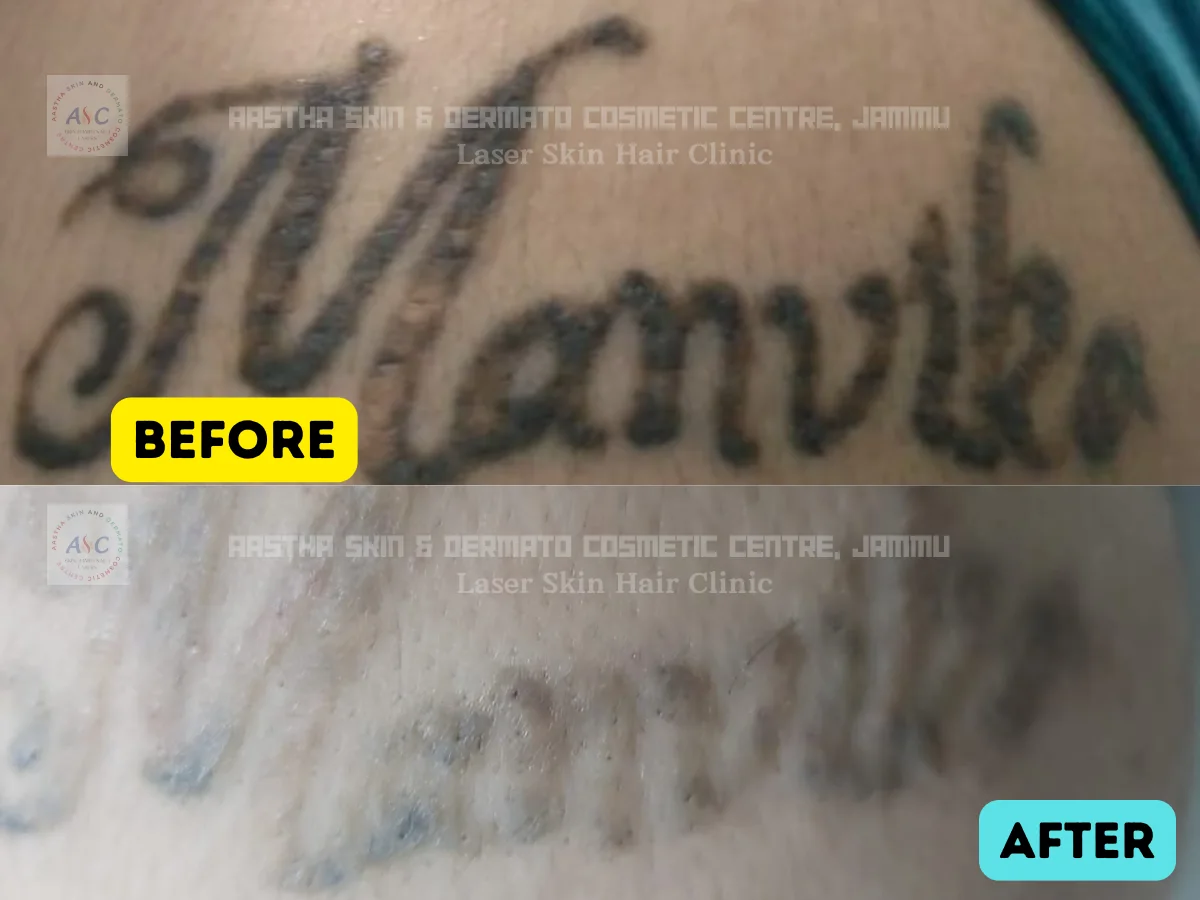
What is laser tattoo removal?
Laser tattoo removal uses short pulses of concentrated light to target tattoo pigment beneath the skin.
When an appropriate laser wavelength reaches the ink:
- The pigment absorbs the laser energy
- The ink breaks into smaller particles
- The surrounding immune system gradually clears some of those particles
- The tattoo becomes lighter over successive sessions
The laser does not physically pull ink out during the appointment. Much of the fading occurs gradually after treatment as the body processes fragmented pigment.
What is a Q-switched Nd:YAG laser?
A Q-switched Nd:YAG laser delivers very short, high-energy pulses designed to target selected tattoo pigments while limiting unnecessary heating of the surrounding skin.
Different wavelengths from this laser family may be used for different colours. Published reviews have evaluated Q-switched Nd:YAG treatment for black and coloured tattoos across different skin phototypes, while also noting that long-term evidence and treatment standardisation remain limited.
Q-switched Nd:YAG technology is listed as available within the Aastha Skin Centre machine inventory. The device’s manufacturer, exact wavelengths and regulatory status should not be claimed until supporting records are available.
Types, options and detailed guidance
Why are several sessions required?
Tattoo ink is deposited in layers within the deeper skin. Trying to destroy all the pigment in one appointment would increase the risk of burns, wounds, pigment changes and scarring.
Several sessions are needed because:
- Only part of the pigment can be treated safely at one time
- Different ink depths respond differently
- The skin requires time to heal
- The body needs time to clear fragmented pigment
- Some colours need different laser wavelengths
- Dense or layered tattoos contain more pigment
Laser treatments are therefore spaced several weeks apart. The exact interval depends on healing, tattoo characteristics and the patient’s skin response.
Can a tattoo be removed completely?
Sometimes substantial clearance is possible, but complete removal cannot be guaranteed.
Possible outcomes include:
- Major fading
- Partial removal
- Enough lightening for a cover-up tattoo
- Residual pigment
- A faint “ghost” outline
- Uneven clearance between colours
- Visible pre-existing tattoo scarring
FDA guidance states that complete removal may take many treatments and may not be achievable in some cases.
The goal should be agreed before treatment: complete removal where realistically possible, substantial fading or preparation for a cover-up.
Which tattoos are easier to remove?
Response depends on several interacting factors.
Tattoos may respond more readily when they are:
- Black or dark blue
- Older
- Less densely packed with ink
- Amateur rather than heavily layered professional tattoos
- Located in an area with good circulation
- Free from significant pre-existing scarring
Dark blue and black pigments are generally easier to target than several bright or pale colours.
Even a small tattoo may require multiple sessions if the pigment is dense or deeply placed.
Which tattoos are harder to remove?
Treatment can be more difficult when the tattoo is:
- Multicoloured
- Recently applied
- Professionally and densely layered
- A cover-up over an older tattoo
- Scarred
- Located on the hands, feet or distant extremities
- Made with resistant pigments
- Cosmetic permanent makeup
- White, beige or flesh-coloured
- Associated with an inflammatory or allergic reaction
Published reviews note that professional and multicoloured tattoos may be particularly time-consuming and can leave residual pigment despite repeated treatment.
Which tattoo colours respond best?
Tattoo colour matters because different pigments absorb different wavelengths of light.
In general:
- Black and dark blue: often respond more predictably
- Red: may respond to a different wavelength from black
- Green: can be more resistant and may require another laser wavelength
- Yellow: often difficult to remove
- White, beige and flesh tones: may darken unexpectedly
- Mixed colours: may need more than one wavelength or treatment approach
The FDA notes that green, red and yellow can be more difficult than dark blue and black.
Not every tattoo colour responds equally; suitability depends on pigment and the available wavelength.
Can cosmetic tattoos and permanent makeup be removed?
Selected cosmetic tattoos may be treatable, including:
- Eyebrow tattoos
- Microblading pigment
- Permanent eyeliner
- Lip-liner tattoos
- Scalp-micropigmentation areas
However, cosmetic pigment requires additional caution.
White, beige, red-brown and flesh-coloured inks may contain compounds that darken after laser exposure. What begins as a pale eyebrow or lip pigment can temporarily or permanently turn grey or black.
A test spot and staged plan may therefore be considered before treating a large cosmetic tattoo.
Can microblading be removed?
Microblading is a form of cosmetic tattooing in which pigment is placed into the skin to simulate eyebrow hairs.
Its response depends on:
- Pigment composition
- Colour
- Depth
- Number of previous sessions
- Scarring
- Skin tone
- Whether pigments have changed colour over time
Some pigments can darken during initial laser treatment. A medical assessment and possible test spot are particularly important before treating eyebrow microblading.
Can a tattoo be lightened for a cover-up?
Yes. Some patients do not need complete tattoo removal.
Laser treatment may be used to:
- Reduce the darkness of an old tattoo
- Lighten dense sections
- Reduce an outline
- Make a future cover-up design easier
- Improve the available colour options for a tattoo artist
The number of sessions needed for cover-up preparation may be lower than the number required for maximal removal.
The tattoo artist should usually wait until the treated skin has fully healed and the final degree of fading can be assessed.
Is laser tattoo removal suitable for Indian skin?
Laser tattoo removal can be performed on Indian and other medium-to-deep skin tones, but there is a greater need to protect the skin’s natural pigment.
Possible pigment-related effects include:
- Temporary darkening
- Temporary lightening
- Prolonged uneven colour
- Rare permanent pigment change
- More visible post-inflammatory marks
Longer-wavelength Q-switched Nd:YAG treatment has historically been used in deeper skin tones, but conservative settings, suitable intervals and test treatment may still be needed.
Tattoo removal carries pigment-change risks, particularly in darker skin, so careful assessment is important.
What affects the number of sessions?
The treatment course may depend on:
- Tattoo size
- Number of colours
- Ink density
- Ink depth
- Professional or amateur application
- Cover-up layers
- Tattoo location
- Patient’s skin tone
- Age of the tattoo
- Existing scarring
- Immune response
- Healing between treatments
- Desired endpoint
No online calculator can predict the exact number of appointments with certainty.
FDA guidance states that treatment duration depends on factors such as tattoo size and colour, and that some tattoos may never clear completely.
How does Dr. Cheena Langer assess a tattoo?
A consultation may include:
- Examining the tattoo’s size and location
- Recording each visible colour
- Reviewing whether it is amateur, professional or cosmetic
- Checking for cover-up layers
- Assessing scars or raised areas
- Examining the surrounding skin tone
- Asking about itching, swelling or tattoo reactions
- Reviewing previous laser or removal treatments
- Checking medicines and medical history
- Discussing complete removal versus lightening
- Explaining likely sessions and limitations
- Considering a test spot
The consultation should also identify moles, suspicious growths or inflammatory reactions hidden within the tattoo.
Additional care and practical advice
Why must moles inside a tattoo be checked?
Tattoo pigment can make it harder to notice changes in a mole or other skin growth.
Before laser treatment, the dermatologist may examine:
A suspicious lesion may need dermoscopy or biopsy before tattoo-removal treatment continues. The AAD recommends dermatologist assessment because skin spots revealed during removal may require investigation.
Surgical excision
A small tattoo may sometimes be cut out and the skin stitched together. This produces a surgical scar and is not suitable for every size or location.
Dermabrasion
The skin surface is mechanically abraded. Results can be unpredictable, and pigment may remain.
Ablative laser treatment
The upper skin layers are removed rather than selectively targeting only tattoo pigment. This can involve greater recovery and scarring risk.
The FDA notes that these methods are now less commonly used because outcomes are variable and unwanted cosmetic effects may be greater.
No. Laser tattoo removal targets ink, not the scar created when the tattoo was originally placed.
A tattoo may already contain:
- Raised scar tissue
- Depressed areas
- Textural change
- Needle-related injury
- Keloid formation
As the pigment fades, pre-existing scarring may become more visible.
Separate scar treatment may be discussed after the tattoo-removal course and complete skin healing.
Dermatologist-led consultation
Treatment planning is provided under Dr. Cheena Langer, MBBS, MD Dermatology, Consultant Dermatologist.
Tattoo and skin are assessed together
Colour, ink density, scarring, skin tone and suspicious growths are reviewed before treatment.
Q-switched laser availability
Q-switched Nd:YAG technology is recorded in the clinic inventory, while unsupported brand and regulatory claims remain excluded.
Care for Indian skin tones
Treatment parameters are selected with attention to post-inflammatory pigmentation and loss of natural skin colour.
Realistic expectations
Patients are counselled that several sessions are required and complete clearance cannot be guaranteed.
Laser tattoo-removal cost depends on:
- Tattoo size
- Number of colours
- Ink density
- Body location
- Professional or amateur tattoo
- Cosmetic tattoo or microblading
- Number of laser sessions
- Anaesthesia required
- Test-spot requirement
- Dressing and follow-up needs
- Complete removal or cover-up lightening goal
Exact pricing is provided after examination. A small black outline requires a different treatment plan from a large, dense or multicoloured professional tattoo.
How care is planned
- Assessment comes before treatment selection.
- Options, limitations, aftercare and expected timelines are explained.
- The plan is adapted to diagnosis, skin type and medical history.
Choose a clinic in Jammu
Karan Nagar
Lane 2, Karan Nagar, near Amphalla Chowk, Jammu – 180005Doctor consultation:
Mon–Sat 11:00 AM–4:00 PM
Sun 11:00 AM–3:00 PM
Paloura Chowk
Top Paloura, opposite Government Senior Secondary School, Jammu – 181121Doctor consultation:
Mon–Sat 6:00 PM–8:00 PM
Sun 10:30 AM–12:00 PM
Frequently asked questions
What happens during a laser tattoo-removal session?
A typical appointment may involve:
- Confirming the tattoo and treatment area
- Taking standardised photographs
- Cleaning the skin
- Covering nearby sensitive areas
- Providing appropriate eye protection
- Applying anaesthesia when indicated
- Selecting suitable treatment parameters
- Delivering laser pulses over the planned area
- Cooling and examining the skin
- Applying a dressing or aftercare product
- Providing written instructions
A temporary white or frosted appearance can occur immediately after laser pulses because of a rapid reaction within the skin.
Is laser tattoo removal painful?
Tattoo removal can be uncomfortable or painful.
Patients commonly describe sensations such as:
- Repeated rubber-band snaps
- Stinging
- Heat
- Pinpricks
- Burning
- Tenderness after treatment
The FDA and AAD both note that numbing cream or local anaesthetic may be used to reduce discomfort.
The website should not promise painless tattoo removal.
What pain-control options may be used?
Depending on the tattoo and patient, comfort measures may include:
- Cooling
- Topical anaesthetic
- Local-anaesthetic injection
- Treatment in smaller sections
- Pauses during treatment
Patients should not apply high-strength numbing cream purchased online without medical guidance.
The FDA has warned about some high-concentration topical anaesthetic products marketed for tattooing and laser procedures because excessive absorption can cause seizures, irregular heart rhythm and breathing problems.
Is there downtime after treatment?
Patients can often continue ordinary non-strenuous activities, but the treated skin needs time to heal.
Temporary effects may include:
- Redness
- Swelling
- Tenderness
- Pinpoint bleeding
- Blistering
- Crusting
- Bruising
- Temporary darkening
- Temporary lightening
- Itching during healing
These reactions vary according to the tattoo, settings, treatment area and individual skin response.
Is blistering normal after tattoo removal?
Small blisters can occur after laser tattoo removal.
Patients should:
- Avoid deliberately bursting blisters
- Keep the area clean
- Follow the prescribed dressing plan
- Avoid picking crusts
- Contact the clinic if blistering is extensive
- Seek review for increasing pain, pus or spreading redness
Large blisters, severe pain, skin breakdown or signs of infection require medical assessment.
What aftercare is recommended?
Clinic-specific instructions take priority. General aftercare may include:
- Keep the area clean
- Apply the recommended ointment or moisturiser
- Cover the area when instructed
- Avoid scratching and picking
- Avoid swimming until the skin heals
- Avoid tight friction over the area
- Avoid waxing or shaving damaged skin
- Avoid strong exfoliating products
- Protect the area from sunlight
- Attend the scheduled review
The AAD advises following wound-care instructions and protecting treated skin from the sun during recovery.
Why is sun protection important?
A recent tan increases the amount of melanin competing with tattoo pigment for laser energy.
Sun exposure before or after treatment may increase the risk of:
- Burns
- Hyperpigmentation
- Hypopigmentation
- Delayed healing
- Uneven results
Patients may be advised to cover the treated area with opaque clothing and use suitable sunscreen after the skin surface has healed. The AAD recommends protecting treated skin from sunlight for an extended period after tattoo-removal treatment.
Get a clear plan for laser tattoo removal
Request a consultation with Dr. Cheena Langer at Karan Nagar or Paloura Chowk.
Medical disclaimer: Results may vary from person to person. This content is for informational purposes only and does not substitute a consultation with a qualified medical professional. Dr. Cheena Langer, MD is a registered medical practitioner.