
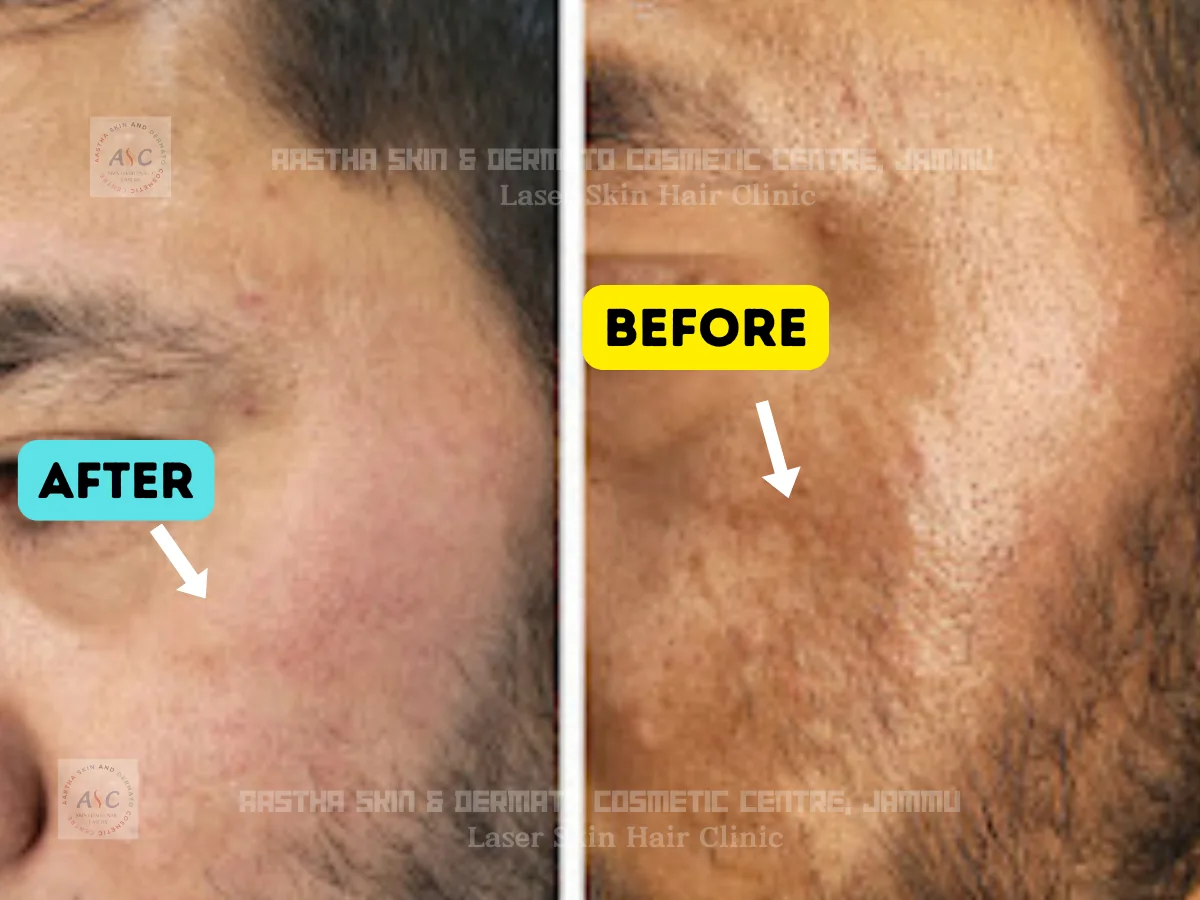
Medical peels selected according to your skin type and concern
Consult Dr. Cheena Langer, MBBS, MD Dermatology, Consultant Dermatologist, for personalised chemical peel treatment at Aastha Skin & Dermato-Cosmetic Centre in Jammu.
Chemical peels may be used for selected concerns involving acne, post-acne marks, melasma, uneven pigmentation, rough texture and sun-related skin changes. The peel solution, strength and treatment schedule are selected only after assessing the diagnosis, skin tone, sensitivity and previous treatment.
Chemical peels are available at both Karan Nagar and Paloura.
What is a chemical peel?
A chemical peel is a controlled skin-resurfacing procedure in which a selected solution is applied to the skin for a planned duration.
The solution causes controlled exfoliation of particular skin layers. As the treated skin heals, it may appear smoother, more even and less congested.
Chemical peels are also called:
- Chemexfoliation
- Medical peels
- Skin-resurfacing peels
- Dermatological peels
A chemical peel should not be confused with an ordinary salon facial. The treatment involves medically active solutions that can cause burns, pigmentation changes or scarring when they are used incorrectly. The FDA has warned against purchasing or using strong chemical-peel products without appropriate professional supervision.
What types of chemical peels are there?
Chemical peels are generally classified according to how deeply they affect the skin.
Types, options and detailed guidance
Which concerns may be treated with chemical peels?
Depending on the patient and peel selected, chemical peels may be considered for:
- Comedonal acne
- Blackheads and whiteheads
- Oily or congested skin
- Post-acne dark marks
- Post-inflammatory hyperpigmentation
- Melasma as part of a combined plan
- Uneven skin tone
- Superficial pigmentation
- Freckles
- Rough skin texture
- Dull-looking skin
- Fine superficial lines
- Selected sun-related changes
Dermatologists use chemical peels for some types of acne and discolouration, as well as selected texture and photoageing concerns.
A peel is not appropriate for every rash, pigmentation problem or acne scar. Diagnosis comes first.
Superficial peels
Superficial peels act mainly on the outer skin layers.
They may be considered for:
- Mild acne
- Blackheads
- Oily skin
- Post-acne marks
- Mild pigmentation
- Dullness
- Superficial roughness
They usually involve less recovery than deeper peels, although temporary redness, dryness or flaking can still occur.
Medium-depth peels
Medium-depth peels reach further into the skin and involve greater recovery and complication risk.
They may be considered for selected pigmentation, texture or photoageing concerns after careful assessment.
Deep peels
Deep peels require substantially greater medical supervision and recovery. They are not a routine substitute for superficial dermatology peels and may require a surgical setting and anaesthesia.
The appropriate peel depth is selected after consultation and not every peel is routinely suitable.
Which peel ingredients may be used?
Different peel agents have different properties. Depending on the diagnosis and skin type, dermatologists may use formulations containing ingredients such as:
- Salicylic acid
- Glycolic acid
- Lactic acid
- Mandelic acid
- Jessner-type combinations
- Trichloroacetic acid in selected strengths
- Retinoid-based peel formulations
- Combination or proprietary medical peels
The ingredient name alone does not determine whether a peel is appropriate. Concentration, pH, number of layers, exposure time, skin preparation and neutralisation can all affect the treatment’s strength.
Patients should not compare two peels only by percentage. A higher percentage is not automatically safer or more effective.
Which chemical peel may be suitable for acne?
Selected peels may help manage:
- Blackheads
- Whiteheads
- Oily skin
- Mild inflammatory acne
- Blocked pores
- Post-acne pigmentation
Salicylic-acid-based and other superficial peels may be used in selected acne plans because they support exfoliation and pore clearance.
However, chemical peels do not replace appropriate medical treatment for moderate, severe, nodular or cystic acne. Active acne may also require prescription creams or oral medicines.
A peel should form part of a complete acne plan rather than being sold as an instant cure.
Can chemical peels treat acne scars?
Chemical peels may improve:
- Post-acne pigmentation
- Superficial textural irregularity
- Selected shallow scars
- Overall skin smoothness
They are less likely to correct deep rolling, boxcar or tethered acne scars when used alone.
Established textural scars may require other procedures such as:
- MNRF
- Microneedling
- Subcision
- TCA CROSS for selected scars
- Fractional CO₂ laser
- Combination scar treatment
The scar type must be examined before treatment.
Can chemical peels help pigmentation?
Yes, selected superficial peels may support treatment for:
- Post-acne pigmentation
- Post-inflammatory hyperpigmentation
- Uneven tone
- Superficial sun-related pigmentation
- Selected melasma cases
Pigmentation treatment should also address:
- Sun exposure
- Visible-light exposure
- Active acne
- Eczema or irritation
- Unsuitable skincare
- Maintenance treatment
Peels can worsen pigmentation when they are too strong, applied incorrectly or performed on irritated skin.
Are chemical peels useful for melasma?
Chemical peels may be used as an additional treatment for selected patients with melasma.
They should usually be combined with:
- Daily photoprotection
- Prescription depigmenting skincare
- Gentle moisturisation
- Trigger management
- Maintenance treatment
Reviews indicate that chemical peels can improve melasma in selected patients, including people with darker skin tones, but recurrence and post-inflammatory pigmentation remain important considerations.
A peel is not a guaranteed permanent cure for melasma.
Is a chemical peel suitable for Indian skin?
Chemical peels can be performed on Indian and other medium-to-deep skin tones, but peel selection and aftercare require particular care.
Deeper skin tones may have a greater tendency to develop:
- Post-inflammatory hyperpigmentation
- Uneven darkening
- Temporary lightening
- Prolonged irritation
- Visible demarcation between treated and untreated skin
The American Academy of Dermatology advises patients with skin of colour to seek a dermatologist experienced in performing peels on similar skin tones because incorrect treatment can cause lasting pigment changes.
Treatment may begin conservatively and be adjusted according to response.
How does Dr. Cheena Langer select a peel?
The consultation may include:
- Confirming the skin concern
- Assessing skin tone and sensitivity
- Reviewing active acne or inflammation
- Examining pigmentation depth
- Reviewing previous peels and lasers
- Asking about prescription acne medicines
- Checking for cold sores
- Reviewing pregnancy or breastfeeding status
- Assessing sun exposure and upcoming travel
- Discussing downtime and realistic expectations
Dr. Cheena Langer may advise another treatment when a chemical peel is unlikely to address the main concern.
Her professional record includes invited faculty activity on chemical peels, supporting their inclusion among her documented areas of dermatology education.
Who may need to postpone a chemical peel?
A peel may need to be postponed or modified when there is:
- Active skin infection
- Open wounds
- Active cold sores
- Severe inflammatory acne
- Sunburn
- Recent tanning
- Significant eczema or dermatitis
- Recent irritating cosmetic procedure
- Recent use of certain acne medicines
- History of abnormal scarring
- Pregnancy-related treatment restrictions
- Inability to avoid sun exposure
- Unrealistic expectations
Patients should disclose all medicines, supplements, previous procedures and history of cold sores before treatment.
Diagnosis before peel selection
The peel is selected according to the condition rather than offering one standard facial peel to every patient.
Dermatologist-led care
Treatment is planned under Dr. Cheena Langer, MBBS, MD Dermatology, Consultant Dermatologist.
Experience with Indian skin tones
Skin tone, pigmentation risk and previous reactions are considered before treatment.
Additional care and practical advice
Documented academic engagement
Dr. Cheena Langer’s professional CV records invited faculty activity on chemical peels.
Two Jammu locations
Chemical peels are confirmed as available at Karan Nagar and Paloura.
Realistic counselling
Patients receive information about expected benefits, possible flaking, downtime, number of sessions and complication risks.
How care is planned
- Assessment comes before treatment selection.
- Options, limitations, aftercare and expected timelines are explained.
- The plan is adapted to diagnosis, skin type and medical history.
Choose a clinic in Jammu
Karan Nagar
Lane 2, Karan Nagar, near Amphalla Chowk, Jammu – 180005Doctor consultation:
Mon–Sat 11:00 AM–4:00 PM
Sun 11:00 AM–3:00 PM
Paloura Chowk
Top Paloura, opposite Government Senior Secondary School, Jammu – 181121Doctor consultation:
Mon–Sat 6:00 PM–8:00 PM
Sun 10:30 AM–12:00 PM
Frequently asked questions
Can a chemical peel be performed during pregnancy?
Some peel ingredients may be unsuitable during pregnancy or breastfeeding.
Patients should inform Dr. Cheena Langer when they:
- Are pregnant
- Are breastfeeding
- Are trying to conceive
- Use hormonal medicines
- Have recently delivered a baby
Elective treatment may be postponed or limited to pregnancy-compatible options depending on the concern and medical assessment.
No patient should assume that a peel is safe during pregnancy simply because it is described as superficial or natural.
How should patients prepare before a peel?
Preparation depends on the peel and skin concern.
Patients may be advised to:
- Use prescribed pre-peel skincare
- Apply sunscreen consistently
- Avoid tanning
- Pause retinoids or exfoliating products when instructed
- Avoid waxing or threading near the treatment area
- Avoid harsh scrubs
- Avoid bleaching
- Report active infection or cold sores
- Stop picking acne lesions
- Inform the clinic about recent procedures
Some patients need a pre-peel skincare programme for approximately two to four weeks to improve results and reduce complications.
Do not stop prescription medicine unless advised by the doctor.
What happens during the procedure?
A typical superficial chemical peel may involve:
- Cleansing and degreasing the skin
- Protecting sensitive areas
- Applying the selected peel evenly
- Monitoring the skin response
- Applying additional layers when appropriate
- Neutralising or removing the peel when required
- Applying soothing skincare and sunscreen
- Providing written aftercare instructions
Patients may experience:
- Tingling
- Warmth
- Mild stinging
- Tightness
- Temporary burning sensation
The treatment is stopped or neutralised according to the peel type and visible skin response.
Is a chemical peel painful?
The sensation depends on:
- Peel ingredient
- Strength
- Number of layers
- Treatment area
- Skin sensitivity
- Barrier condition
- Previous preparation
A superficial peel may cause temporary tingling or stinging. Medium and deeper peels can cause greater discomfort and require more intensive pain control.
The website should not describe every peel as painless.
What happens after a chemical peel?
After a superficial peel, patients may notice:
- Redness
- Tightness
- Dryness
- Mild swelling
- Flaking
- Temporary sensitivity
- Darkening before peeling
- Increased sensitivity to sunlight
Healing time varies according to peel depth. The AAD notes that superficial peel recovery may take approximately one to seven days, while deeper treatment requires longer healing and more extensive wound care.
Not every superficial peel causes visible sheets of peeling. A peel can still have an effect without dramatic shedding.
What aftercare is required?
Patients may be advised to:
- Use a gentle cleanser
- Apply the prescribed moisturiser
- Use sunscreen daily
- Avoid picking or peeling skin
- Avoid scrubs
- Pause retinoids and exfoliating acids
- Avoid waxing or threading temporarily
- Avoid excessive heat and steam
- Avoid heavy exercise when instructed
- Delay makeup until advised
- Contact the clinic for severe pain or blistering
Picking flaking skin can increase the risk of infection, pigmentation and scarring. Sun protection and appropriate wound care are essential after treatment.
What side effects are possible?
Common temporary effects include:
- Redness
- Dryness
- Flaking
- Tightness
- Mild swelling
- Temporary sensitivity
Potential complications include:
- Post-inflammatory hyperpigmentation
- Prolonged redness
- Uneven lightening
- Chemical burn
- Infection
- Cold-sore reactivation
- Persistent irritation
- Scarring
Complication risk increases with stronger peels, poor patient selection, at-home treatment, sun exposure and failure to follow aftercare instructions.
Get a clear plan for chemical peel
Request a consultation with Dr. Cheena Langer at Karan Nagar or Paloura Chowk.
Medical disclaimer: Results may vary from person to person. This content is for informational purposes only and does not substitute a consultation with a qualified medical professional. Dr. Cheena Langer, MD is a registered medical practitioner.