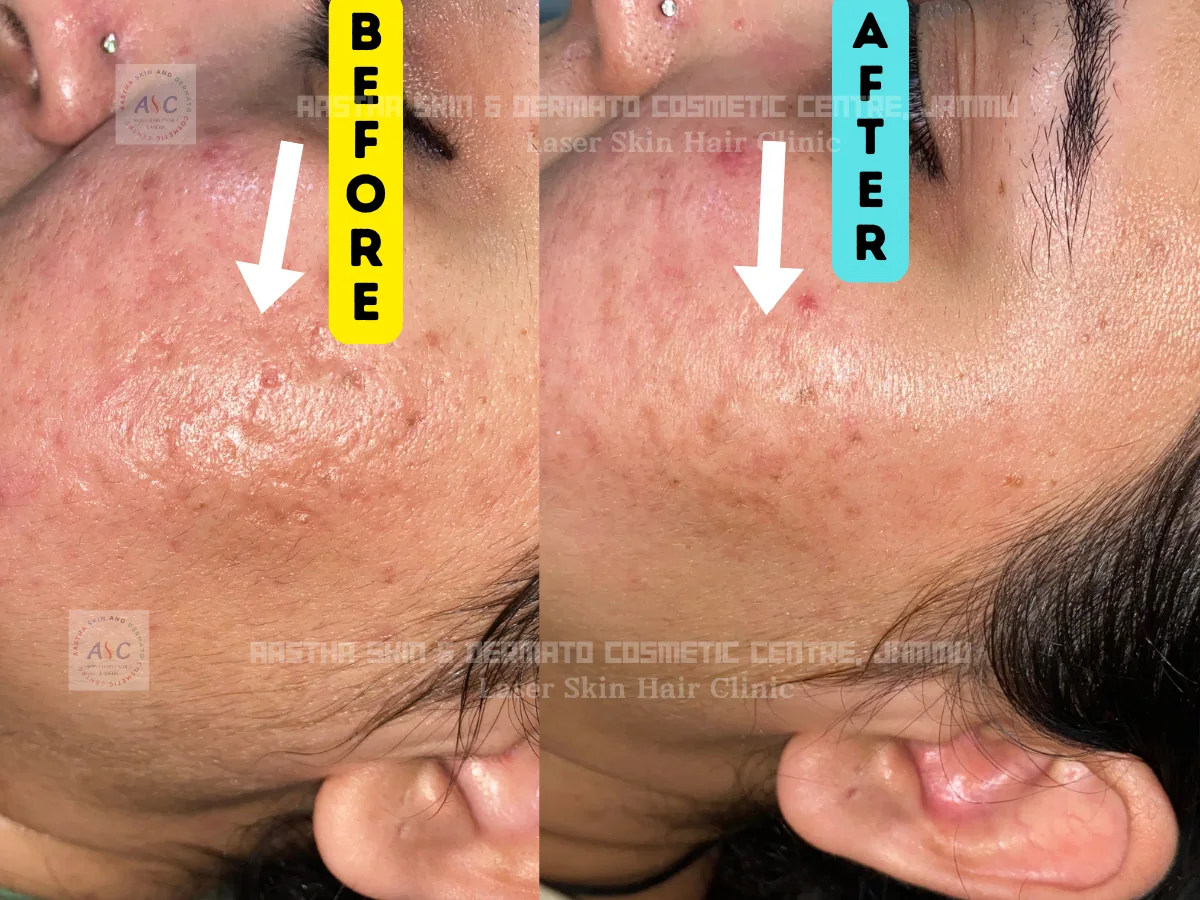
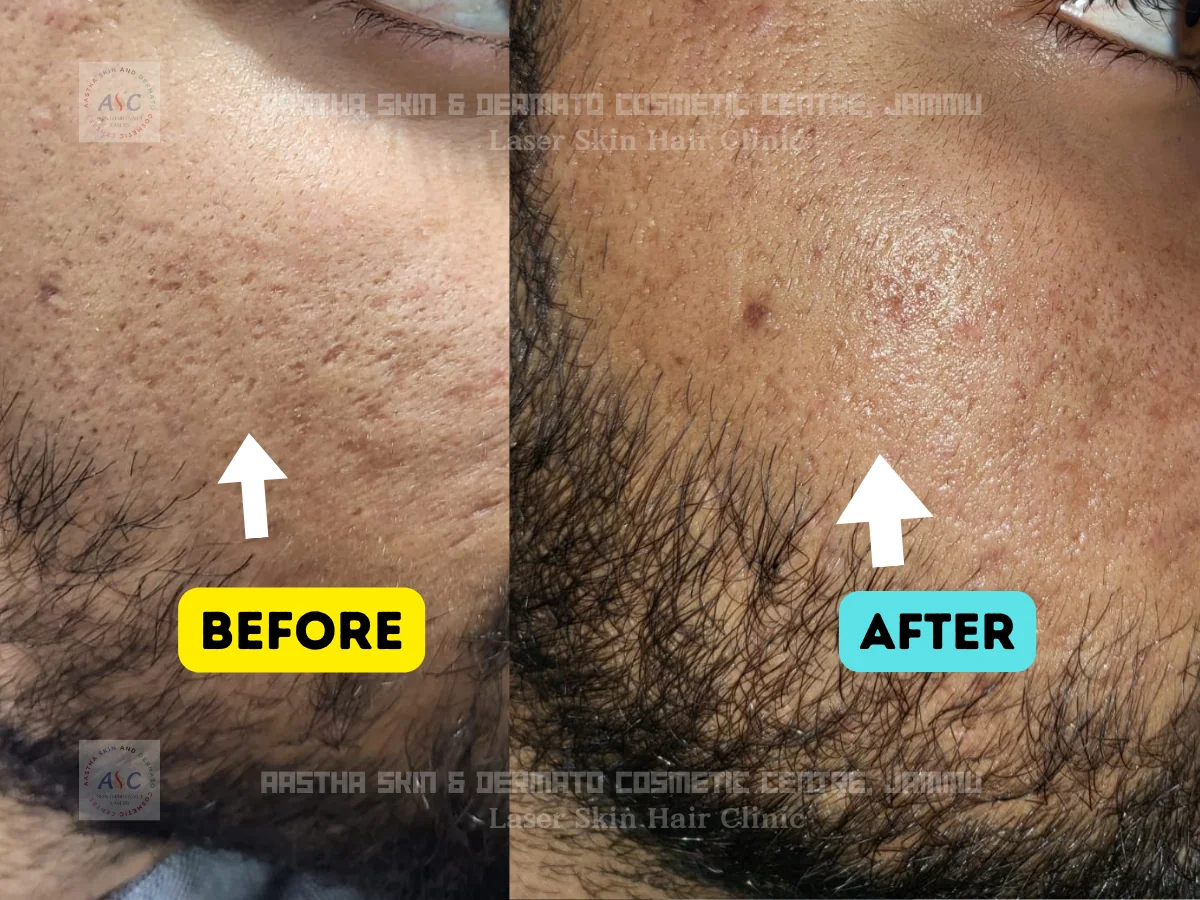
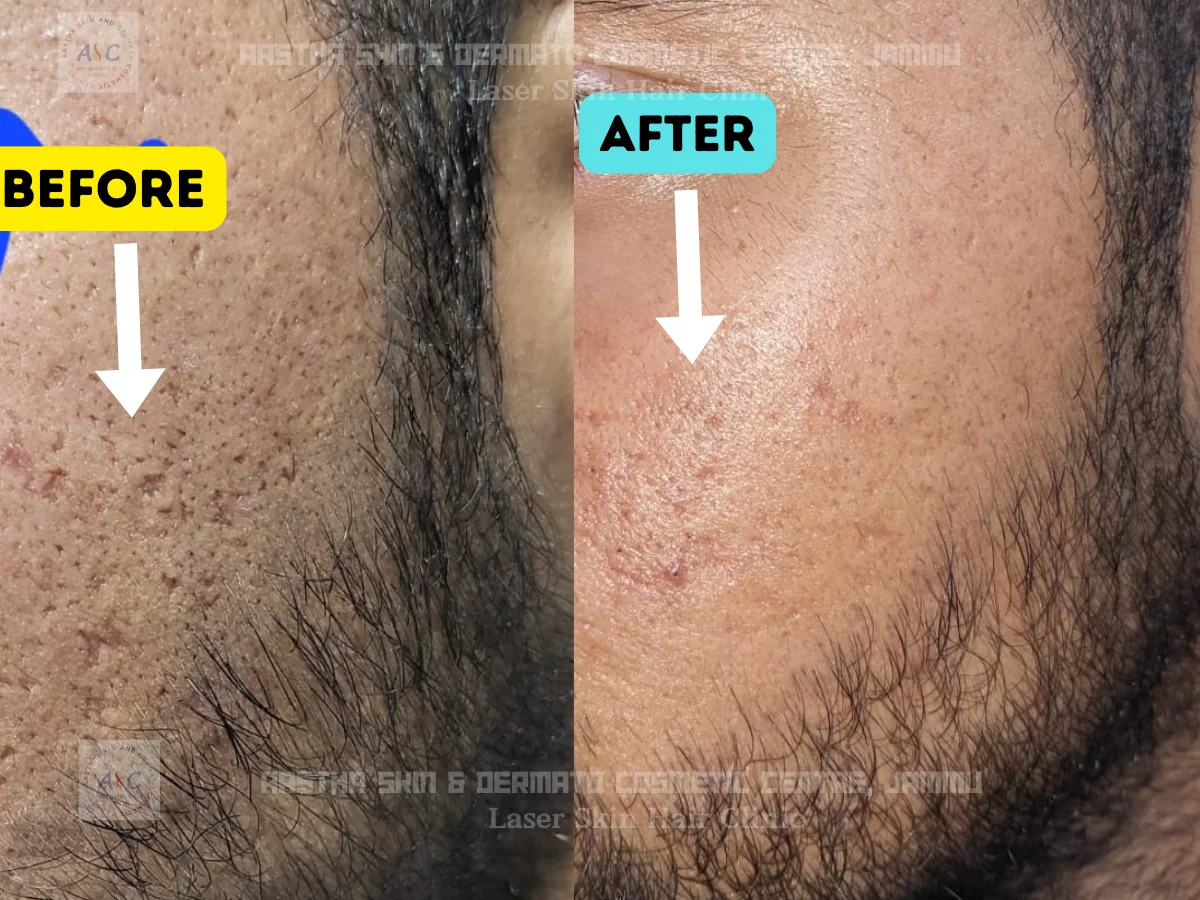
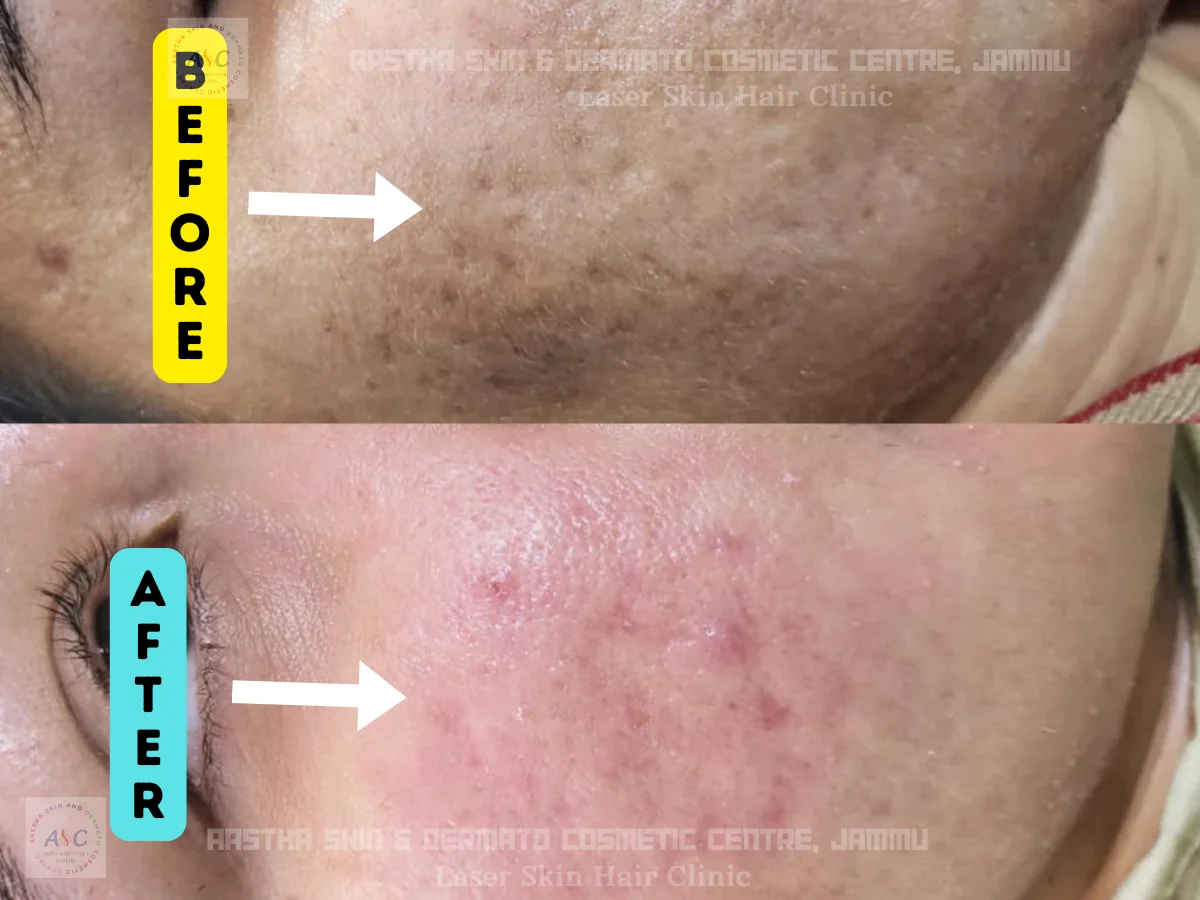
Personalised treatment for rolling, boxcar and ice-pick acne scars
Consult Dr. Cheena Langer, MBBS, MD Dermatology, Consultant Dermatologist, for diagnosis-led acne scar treatment at Aastha Skin & Dermato-Cosmetic Centre in Jammu.
Acne scars do not all behave in the same way. Treatment is planned after assessing the scar type, depth, skin tone, active acne, pigmentation tendency and acceptable downtime.
Acne scar procedures, MNRF and fractional CO₂ laser are available at both the Karan Nagar and Paloura branches.
When should acne scar treatment begin?
Scar treatment usually begins after active acne is reasonably controlled. Continuing breakouts can create new scars while older scars are being treated.
Patients may be advised to continue acne medication or maintenance skincare during their scar-treatment course.
A consultation is especially useful when:
- Scars are becoming more noticeable
- Acne has left deep pits or uneven texture
- Makeup does not sit evenly on the skin
- Scarring affects confidence
- Previous treatments produced limited improvement
- Dark marks and textural scars are present together
- The patient has a history of keloids
- Active acne is still recurring
Types, options and detailed guidance
What are acne scars?
Acne scars are permanent changes in skin texture that remain after acne inflammation has healed. They commonly develop after deep nodules or cysts, and the risk can increase when pimples are picked, scratched or squeezed.
Acne scars may be:
- Depressed below the skin surface
- Raised above the surrounding skin
- Narrow and deep
- Broad and shallow
- Tethered to deeper tissue
- Associated with redness or pigmentation
Dark or red marks left after acne are not always true scars. They may represent post-inflammatory colour changes without permanent textural damage.
Ice-pick scars
Ice-pick scars are narrow but extend deeply into the skin. They often look like small holes or punctures.
Boxcar scars
Boxcar scars are round or oval depressions with more clearly defined edges. They may be shallow or deep.
Rolling scars
Rolling scars are broad, shallow depressions that can give the skin a wavy appearance. Some are held down by fibrous bands beneath the skin.
Hypertrophic scars
Hypertrophic scars are raised, firm scars caused by excessive collagen formation. They commonly remain within the original area of inflammation.
Keloid scars
Keloids are raised scars that may extend beyond the original acne lesion. Raised scars require a different approach from depressed scars.
Many patients have more than one scar type, which is why a combination treatment plan may be recommended.
Acne marks
Acne marks are changes in colour left after inflammation. They may appear:
- Brown
- Grey-brown
- Red
- Pink
- Purple
The skin surface usually remains smooth.
Acne scars
Acne scars cause a lasting change in texture. The skin may look depressed, pitted, wavy or raised.
Pigmentation treatment cannot lift a deep scar, while resurfacing alone may not completely correct dark marks. Each concern should therefore be assessed separately.
How does Dr. Cheena Langer assess acne scars?
An acne scar consultation may include:
- Identifying each scar type
- Assessing scar depth and distribution
- Checking whether scars are tethered
- Looking for active acne
- Evaluating pigmentation and redness
- Reviewing skin tone and sensitivity
- Asking about previous procedures
- Assessing keloid tendency
- Discussing recovery time and expectations
- Preparing a staged treatment plan
The dermatologist also considers age, scar duration, medical history, budget and the amount of downtime the patient can manage.
Which acne scar treatments may be considered?
Acne scar treatment is rarely one-size-fits-all. Dermatologists may use more than one technique because different scar types respond differently.
Possible options include:
- MNRF
- Microneedling
- Subcision
- Fractional CO₂ laser
- Focal treatment for selected deep scars
- Chemical peels for associated pigmentation
- PRP-supported procedures
- Scar revision in selected cases
- Combination treatment plans
The appropriate option depends on the scar pattern and individual skin assessment.
What is MNRF for acne scars?
MNRF stands for microneedling radiofrequency. Fine needles deliver controlled radiofrequency energy into selected skin depths to support collagen remodelling.
MNRF may be considered for:
- Rolling scars
- Selected boxcar scars
- Uneven skin texture
- Enlarged pores
- Mixed atrophic acne scars
Radiofrequency microneedling has evidence supporting its use for acne scarring, although treatment settings, study methods and results vary. Further high-quality studies are still needed to define ideal protocols.
Temporary effects can include:
- Redness
- Mild swelling
- Tenderness
- Pinpoint crusting
- Temporary sensitivity
- Short-term darkening in some patients
Several sessions may be recommended depending on scar severity and response.
What is fractional CO₂ laser for acne scars?
Fractional CO₂ laser creates controlled microscopic treatment zones in the skin. Healing and collagen remodelling can gradually make selected depressed scars less noticeable.
It may be considered for:
- Boxcar scars
- Mixed atrophic scars
- Uneven texture
- Selected rolling scars
- Certain surgical or chickenpox scars
Recovery may involve:
- Redness
- Swelling
- Crusting
- Peeling
- Temporary sensitivity
- Post-inflammatory pigmentation
Recent comparative reviews indicate that fractional CO₂ laser and needling-based treatments can both improve atrophic acne scars. Fractional CO₂ may provide stronger improvement in some comparisons but can carry a higher risk of post-inflammatory hyperpigmentation and longer recovery, making skin type and individual risk important considerations.
Individual scar assessment
Treatment is chosen according to scar type, depth and skin tone rather than offering one procedure to every patient.
Active acne and scar care together
New breakouts are addressed to reduce the risk of additional scars.
Additional care and practical advice
Multiple procedural options
The clinic’s confirmed service record includes acne scar procedures, MNRF and fractional CO₂ laser at both branches.
Dermatologist-led planning
Care is provided under Dr. Cheena Langer, MBBS, MD Dermatology, Consultant Dermatologist.
Two Jammu locations
Patients can consult at Karan Nagar or Top Paloura.
Realistic counselling
The treatment plan should explain expected improvement, number of sessions, possible downtime and limitations.
Begin with an assessment of your scar type, book an acne scar consultation with Dr. Cheena Langer at Aastha Skin Centre, Jammu.
How care is planned
- Assessment comes before treatment selection.
- Options, limitations, aftercare and expected timelines are explained.
- The plan is adapted to diagnosis, skin type and medical history.
Choose a clinic in Jammu
Karan Nagar
Lane 2, Karan Nagar, near Amphalla Chowk, Jammu – 180005Doctor consultation:
Mon–Sat 11:00 AM–4:00 PM
Sun 11:00 AM–3:00 PM
Paloura Chowk
Top Paloura, opposite Government Senior Secondary School, Jammu – 181121Doctor consultation:
Mon–Sat 6:00 PM–8:00 PM
Sun 10:30 AM–12:00 PM
Frequently asked questions
What is subcision?
Subcision is a minor procedure used for selected depressed scars that are pulled down by fibrous bands beneath the skin.
A fine needle or suitable instrument is passed under the scar to release the tethering. Once released, the depressed area may rise and collagen remodelling can occur during healing.
Subcision is most often considered for:
- Rolling scars
- Tethered depressions
- Broad, sunken scars
- Scars that become smoother when the surrounding skin is stretched
It may be combined with microneedling, MNRF, laser or another scar procedure when appropriate. The AAD describes surgical lifting or release of depressed scars as one of the procedural approaches dermatologists may use.
What is microneedling?
Microneedling uses fine sterile needles to create controlled micro-injuries in the skin. This stimulates healing processes and collagen production that may gradually reduce the appearance of selected depressed scars.
It may be used alone or combined with:
- Radiofrequency
- PRP
- Chemical peeling
- Subcision
- Other scar procedures
The American Academy of Dermatology notes that microneedling is used for depressed acne scars and can be combined with radiofrequency or PRP.
Can PRP be combined with acne scar treatment?
Platelet-rich plasma, or PRP, may be used as a supportive treatment alongside procedures such as microneedling.
PRP is prepared from the patient’s own blood and contains platelets and associated growth factors. It is generally used to support healing rather than as a stand-alone answer for every scar type.
Its suitability depends on the main procedure, skin condition, medical history and treatment plan.
Can chemical peels treat acne scars?
Chemical peels may help with:
- Post-acne pigmentation
- Mild textural irregularity
- Comedonal acne
- Superficial skin roughness
- Selected shallow scars
They are less likely to correct deep, tethered scars when used alone.
Peel type and strength should be selected according to skin tone, active acne, sensitivity and pigmentation risk.
Why are combination treatments often used?
A patient may have rolling scars, boxcar scars, ice-pick scars and pigmentation at the same time. One procedure cannot address every component equally.
A staged plan may therefore involve:
- Subcision for tethered rolling scars
- MNRF for collagen remodelling
- Fractional CO₂ for selected texture concerns
- Focal treatment for narrow deep scars
- Peels or skincare for pigmentation
- Continued acne control to prevent new scars
The AAD notes that dermatologists often combine treatments to address different scar patterns and improve overall results.
How many sessions are needed?
The number of sessions depends on:
- Scar type
- Scar depth
- Treatment selected
- Skin response
- Previous procedures
- Downtime available
- Pigmentation tendency
- Desired degree of improvement
Acne scar treatment is rarely completed in one session. Some patients require three or more sessions, and collagen improvement may continue gradually after treatment.
The final session plan should be given only after examination.
Can acne scars be removed completely?
Treatment can make acne scars less noticeable, improve texture and soften sharp transitions between scarred and normal skin.
Complete scar removal cannot be guaranteed. Results vary according to scar type, depth, skin tone, healing response and adherence to aftercare.
The goal is realistic, progressive improvement rather than perfectly unscarred skin.
Get a clear plan for acne scar
Request a consultation with Dr. Cheena Langer at Karan Nagar or Paloura Chowk.
Medical disclaimer: Results may vary from person to person. This content is for informational purposes only and does not substitute a consultation with a qualified medical professional. Dr. Cheena Langer, MD is a registered medical practitioner.